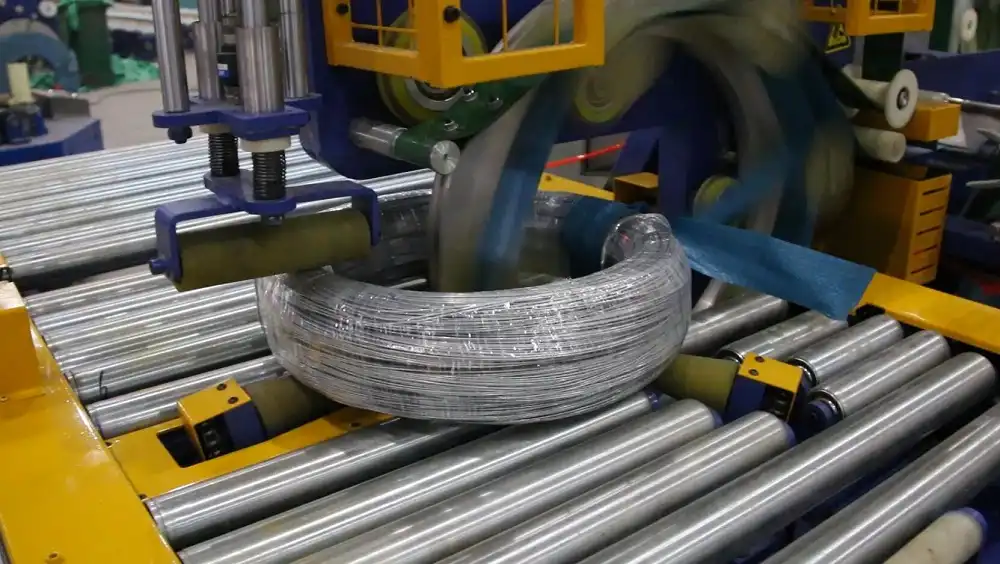
Resumen ejecutivo We pack steel wire automatically on a coiler that measures the wire, winds it into a coil, cuts it at the set length and straps it through the eye. The winder runs at 200–800 m/min and makes about 20 coils an hour on one head or 40 on two. The strapping head ties PP strap at 2–6 points, with joints at about 75–80% of the strap's breaking load. A worked example turns a coil weight into wire length and checks the hourly rate.
Índice
- From drawn wire to a sellable coil
- Accumulator, meter counter, winder, cutter and strapper
- One coil, step by step
- Coiling and strapping data
- Worked example: wire length and coils per hour
- How strong is a PP strap joint
- Lista de selección: qué enviarnos
- Seguridad y EN 415-10
- Preguntas frecuentes sobre ingeniería
- El próximo paso
- Lectura relacionada
- Fuentes
From drawn wire to a sellable coil
Tie wire, binding wire and small steel wire coils are sold by length or weight. Every coil has to hold its shape, carry the right length and stay tied until the customer opens it. Winding and tying by hand gives uneven coils and wrong lengths.
An automatic coiler takes the wire straight from the line. It counts the length, winds a regular coil, cuts the wire and straps the coil before it leaves the machine. The finished coils stack in rows, ready for pallets or cartons.
Accumulator, meter counter, winder, cutter and strapper
Vertical accumulator. It stores 5–20 m of wire and keeps the tension steady, so the winder does not overstretch or break the wire. Limit switches stop the machine if the wire breaks.
Meter counter. Upper and lower encoder wheels count the length to the centimetre. The lower wheel is PU covered so it does not deform the wire, and a one-way bearing stops the wire running back.
Winder head. A servo-controlled traverse lays the wire for a regular coil shape. The head stops at the set length and opens to release the coil.
Cortador. A portal cutter in vacuum-hardened alloy steel cuts the wire at the set length.
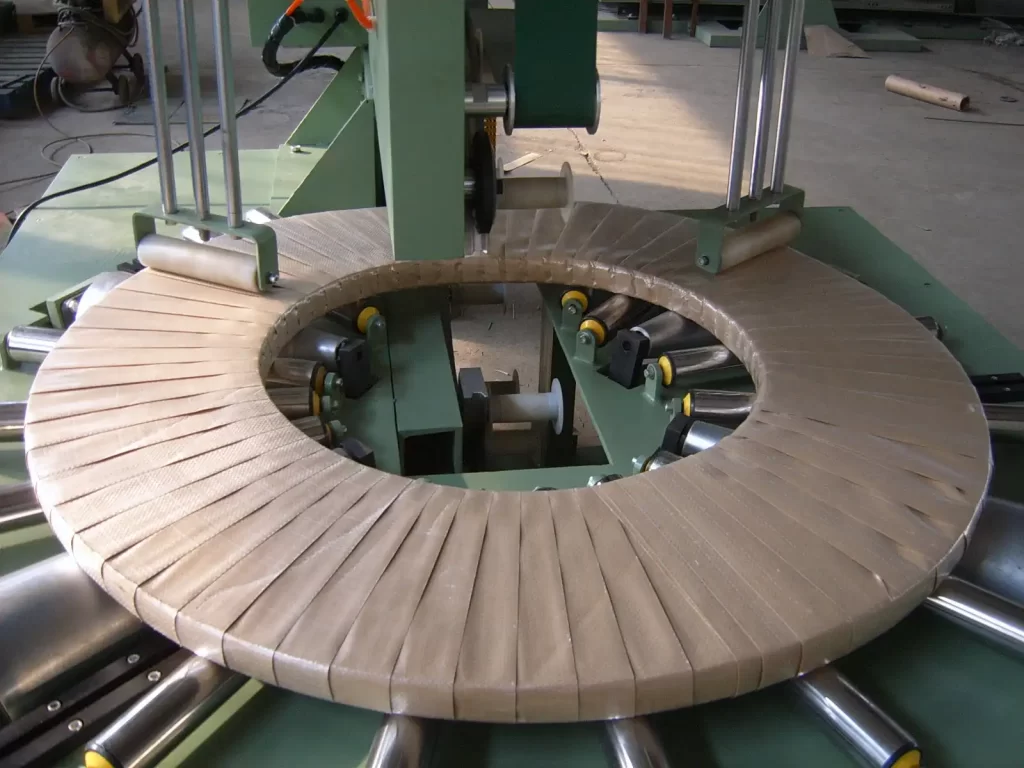
Strapper. The head feeds PP strap through the coil eye, tensions it and seals it by friction weld, at 2–6 points round the coil.
One coil, step by step
- The wire runs from the accumulator through the meter counter.
- The winder head takes up the wire, and the traverse lays it evenly.
- Close to the set length, the winder slows down. At the length, it stops.
- The cutter cuts the wire.
- A holder clamps the coil and moves it to the strapping station.
- The strapper ties it at the programmed points, and the coil is released.
With two heads, one winds while the other is cut and strapped, so the wire does not stop.
Coiling and strapping data
| Parámetro | Enrollador automático de alambre |
|---|---|
| Velocidad de bobinado | 200-800 m/min |
| Resultado | about 20 coils/h on one head, 40 on two |
| Length count | a 0.01 m |
| acumulador | 5–20 m of wire |
| Altura del centro | A 1,000 mm del suelo |
| Suministro | 380 o 440 V, 60 Hz |
| Correa | PP, 8–10 mm wide, 0.8 mm thick |
| Strapping points | 2–4 on the compact coiler, 3–6 on the high-speed line |
| Conjunto | friction (vibration) weld, at the front of the coil |
| Eficiencia conjunta | about 75–80% of the strap's breaking load |
| Control | PLC and HMI with stored recipes |
The PLC stores coil recipes. To change product, the operator loads a stored recipe for length, coil width and wire diameter.
Worked example: wire length and coils per hour
A plant sells 25 kg coils of 2.0 mm steel wire and needs 18 coils an hour from one line. These are illustrative customer figures.
Wire length per coil. The wire's cross-section is π ÷ 4 × 2.0² = 3.14 mm². At 7,850 kg/m³, one metre weighs 3.14 × 10⁻⁶ × 7,850 = 0.0247 kg. So a 25 kg coil is 25 ÷ 0.0247 = 1,014 m.
Winding time. At 400 m/min, 1,014 ÷ 400 = 2.5 min, or about 152 s. At the top speed of 800 m/min it is 76 s.
Single head. 18 coils an hour gives 3,600 ÷ 18 = 200 s per coil. Winding takes 152 s, so 200 − 152 = 48 s are left for slowing, cutting, strapping and release. Time your own strapping cycle t against that 48 s before you choose one head or two.
Regla general. Coils per hour per head = 3,600 ÷ (L ÷ v + t), where L is wire length, v the winding speed and t the cut-and-strap time for your coil. Thinner wire means a longer L for the same weight, so it needs a faster v or two heads.
How strong is a PP strap joint?
The joint is a friction weld: the head vibrates the two strap layers until they fuse. It holds about 75–80% of the strap's own breaking load. So the tie strength is 0.75 to 0.80 × the strap's breaking load, times the number of straps.
If a coil springs open in handling, add strapping points before changing strap. The 3–6 point strapper also takes 10 mm strap.
Lista de selección: qué enviarnos
- Wire type and diameter range.
- Coil weight or length, and coil ID, OD and width.
- Line speed of the wire coming in.
- Bobinas por hora.
- Strap: PP width and number of points.
- How coils leave: conveyor, pallet or carton.
Seguridad y EN 415-10
For CE markets we follow EN 415-10 as the reference, with a risk assessment to ISO 12100. The main hazards are the turning winder head, the wire under tension, the cutter and the strapping head.
The machine stops at once if the wire breaks, and limit switches guard both ends of the accumulator. Keep hands out of the winder and cutter area while the line runs, and fence the cell where coils are handled.
Preguntas frecuentes sobre ingeniería
Q: Can we change coil length while the machine runs? A: Yes. Coil length and wire speed can be set on the HMI during running. For a new wire diameter, load the matching stored recipe.
Q: How accurate is the length? A: The meter counter counts to the centimetre, and the winder slows down before the set length.
Q: Can it run with our drawing line? A: Yes. The accumulator and synchronous take-up control match the winder to the incoming wire.
P: ¿Conforme a qué normas fabrican? R: Conformemos a la norma EN 415-10 como referencia CE, con una evaluación de riesgos según la norma ISO 12100.
El próximo paso
- Email your wire size, coil weight and coils per hour a info@fhopepack.com.
- Le responderemos en un plazo de 24 horas con una propuesta., with one or two heads and the strap layout.
- Enviamos un plano de distribución. for the end of your wire line.
Lectura relacionada
- Automatic wire coiler with strapping
- Máquina automática para enrollar y flejar alambre de acero
- Cómo elegir una línea de embalaje para bobinas de cable de acero
- Automatic steel wire coiler for wire winding and strapping
Fuentes
- Specifications: FHOPE automatic wire coiler and automatic steel wire coiling and strapping product pages
- Video de la máquina: steel wire coiling and strapping on YouTube
- Wire length and coils per hour: our worked example, illustrative wire figures
- Normas: EN 415-10 (máquinas de envasado, seguridad general); ISO 12100:2010
Última revisión: 17/10/2026