> **Resumen ejecutivo**
> Finished aluminum profiles scratch when they slide over each other or are carried by hand.
> Our line in this video carries the profiles on conveyors, transfers them with a robot arm above the line and covers them in film, keeping each profile level from start to end.
> Tape and film use follow from the **profile length** and the **profiles per bundle**. We set both per project.
Índice
- Encintado en línea, transferencia robótica y envoltura continua
- Cómo funciona la línea de perfil
- Cinta protectora utilizada por paquete
- Reglas de configuración de línea
- Integración en una línea de perfil existente
- Controles, instalación y seguridad
- Lista de verificación para la selección de una línea de empaquetado de perfiles de aluminio
- Preguntas frecuentes sobre ingeniería
- El próximo paso
- Lectura relacionada
- Fuentes
Encintado en línea, transferencia robótica y envoltura continua
La manipulación manual y la fricción entre perfiles son las causas principales de los daños superficiales en el embalaje por extrusión. Esta línea integra cinta protectora en línea, transferencia robótica y envoltura continua para que los perfiles permanezcan orientados, separados y nivelados desde la entrada hasta la salida, sin necesidad de detener la línea para cada paquete.
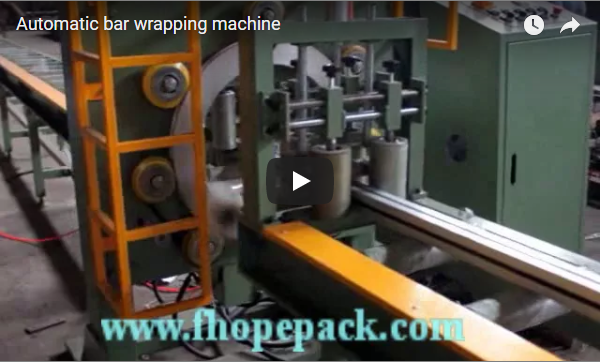
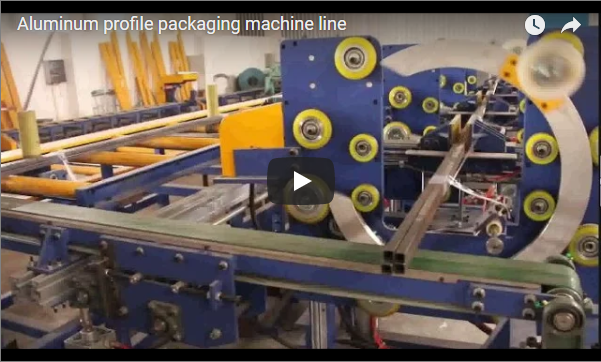
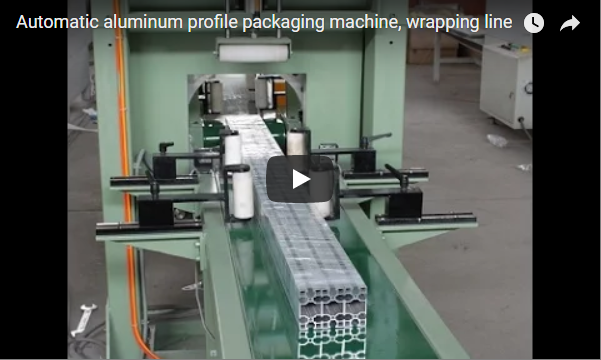
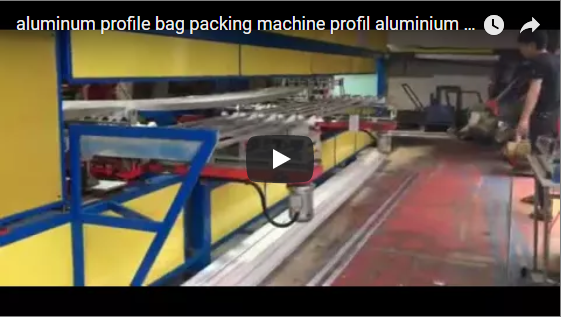
El vídeo muestra esa secuencia en orden: entrada en la cinta transportadora, transferencia robótica al ritmo de la línea, aplicación de cinta y película, y salida nivelada en el extremo opuesto.
Cómo funciona la línea de perfil
| Paso | Qué sucede |
|---|---|
| Feed | Profiles enter on the conveyor |
| Transfer | The robot arm picks and places them in step with the line |
| Tape | Yellow units along the line apply the protective tape |
| Cover | Profiles move on, covered in clear film |
| Output | Profiles leave the far end, still level |
Mantener los perfiles nivelados y espaciados evita que uno se deslice sobre otro, que es donde suelen aparecer la mayoría de las marcas en la superficie.
Cinta protectora utilizada por paquete
Ejemplo ilustrativo con dos tiras de cinta protectora a lo largo de cada perfil:
| Artículo | Valor |
|---|---|
| Profile length (illustrative) | 6,000 mm |
| Strips per profile (illustrative) | 2 |
| Tape per profile, 2 × 6 m | 12 m |
| Profiles per bundle (illustrative) | 20 |
| Tape per bundle, 20 × 12 m | 240 m |
Al planificar los rollos de cinta, añada el extremo inicial en cada extremo de la tira.
Reglas de configuración de línea
| Requirement | Configuration | Selection rule |
|---|---|---|
| Visible faces only | Decorative-face taping | When unexposed faces need no film; selection per project |
| Full cover | Film over the whole profile | For long-distance or open transit; selection per project |
| Variable lengths | Conveyor and robot set to the length range | Sized to the mill's cutoff length spectrum |
| High output | Second robot arm or wrapping station | When mill throughput exceeds one station's cycle time |
The line can also add a [protective film applicator](https://www.fhopepack.com/videos/automatic-aluminum-profile-tape-applicator-video/) ahead of the conveyor. Tell us the profile shapes and lengths, and we lay out the conveyor, robot and wrapping stations around them.
Integración en una línea de perfil existente
La línea está diseñada para integrarse con una salida de extrusión o acabado existente, de modo que los perfiles terminados puedan introducirse directamente en lugar de ser transportados a mano. Dos detalles permiten su funcionamiento con diferentes tamaños de paquetes:
- **Self-adjusting rollers.** The rollers open and close to take different bundle widths without stopping the line.
- **Fast film change.** A film roll change is set up for a quick swap, so a long run is not interrupted for material.
Si necesita el conjunto completo de estaciones, la línea combina el atado de subpaquetes, el embalaje de subpaquetes, una apiladora, una selladora de cajas y la estación de embalaje de vía principal, todo ello en el mismo control de línea.
Controles, instalación y seguridad
The robot arm moves over the conveyor and profiles travel along the line. Keep people out of the robot's reach while the line runs, and clear a profile only with the line stopped.
Las normas aplicables dependen del mercado de destino. Para los mercados CE, la norma ISO 12100 establece el método de evaluación de riesgos y la norma EN 415-10 establece los requisitos generales para las máquinas de envasado.
Lista de verificación para la selección de una línea de empaquetado de perfiles de aluminio
- [ ] Profile shapes, lengths and weights.
- [ ] Faces that need tape or film.
- [ ] Profiles per bundle.
- [ ] Profiles per hour.
- [ ] Line length and floor space.
- [ ] Infeed from the extrusion or finishing line.
Preguntas frecuentes sobre ingeniería
Q: How are profiles transferred?
A: A robot arm above the conveyor picks and places them in step with the line.
Q: How much tape does a bundle take?
A: About 240 m net for 20 profiles of 6,000 mm with two strips each in our example, before lead-in at the strip ends.
Q: Do the profiles turn over on the line?
A: No. They stay level and in the same direction from infeed to output.
Q: Can the line tape only the visible faces?
A: Yes. It can tape the decorative faces only or cover the whole profile in film.
Q: Can the line take different lengths?
A: Yes, when the conveyor and robot are set to your length range.
Q: Where is the line controlled?
A: At the main control cabinet with the signal tower at the infeed end of the line.
Q: How does the conveyor adapt to different profile bundle widths?
A: Self-adjusting rollers open and close automatically to match bundle width, without stopping the line.
Q: What downstream equipment can integrate with this line?
A: Sub-bundle tying, sub-bundle wrapping, a stacker, a case sealer and the main-track wrapping station, all on the same line control.
El próximo paso
Planificamos su línea de embalaje de perfiles de aluminio en tres pasos:
1. **Submit your layout drawing** with profile shapes, lengths and output to **info@fhopepack.com**.
2. **Receive a proposal within 48 hours**, with the tape and film plan.
3. **Solicite una visita técnica** para comprobar la distribución de las líneas y el espacio disponible.
Lectura relacionada
- [Aluminum profile packing](https://www.fhopepack.com/Aluminum/)
- [Video: aluminum horizontal wrapping machine with spacer feeder](https://www.fhopepack.com/videos/aluminum-horizontal-wrapping-machine-with-spacer-feeder/)
- [Video: automatic aluminum profile packaging line for paper packing and stacking](https://www.fhopepack.com/videos/automatic-aluminum-profile-packaging-line-for-paper-packing-and-stacking/)
- [Video: aluminum profile packing machine and wrapping line: stations and pace](https://www.fhopepack.com/videos/aluminum-profile-packing-machine-and-wrapping-machine-line-2/)
- [Video: automatic aluminum film applicator: inline taping of profiles](https://www.fhopepack.com/videos/automatic-aluminum-film-applicator/)
Fuentes
- Contenido de la línea: Equipo de ingeniería de FHOPE, 04/10/2026
- Tape example: our worked example, illustrative values
- Machine in action: [our video on YouTube](https://www.youtube.com/watch?v=jYEZdjC4q4g)
- Alcance de las normas: [ISO 12100:2010](https://www.iso.org/standard/51528.html), [EN 415-10:2014](https://www.nen.nl/en/nen-en-415-10-2014-en-191845)
Última revisión: 09/10/2026