Resumen
Long aluminum profiles are scratch-sensitive along their full length and difficult to wrap evenly by hand at the end of an extrusion or finishing line. An automatic aluminum profile packaging line mechanizes this step: it carries a bundle of profiles through a wrapping ring on a roller conveyor, applies protective film in a consistent spiral, and delivers the wrapped bundle to the outfeed for bundling or strapping.
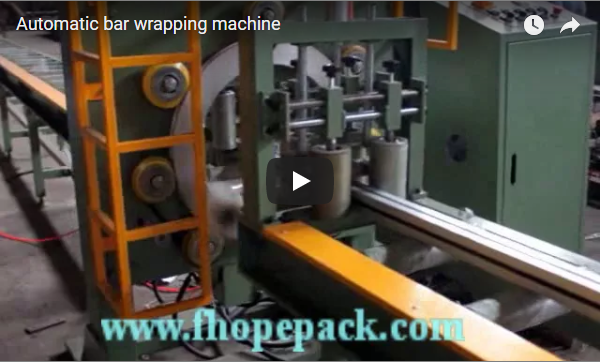
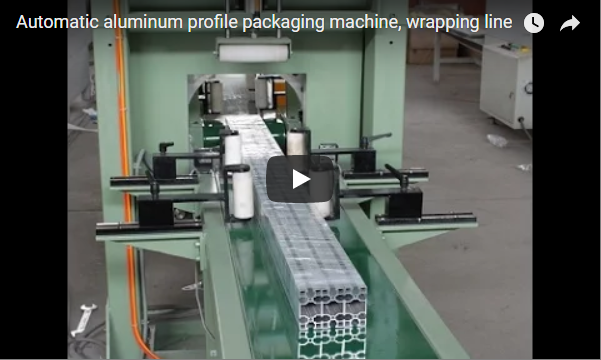
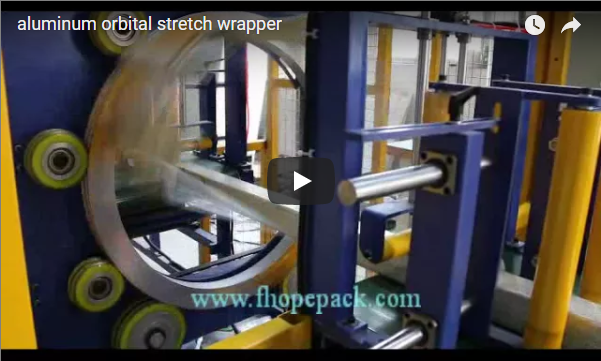
This page is written for project engineers and production managers at aluminum extrusion and finishing plants who are evaluating such a line. It explains what the line does, why ring-style wrapping keeps each profile straight, and which specification points to confirm with a supplier before purchase. The video below shows the wrapping stage running on an automatic aluminum profile packing line.
What an Aluminum Profile Packaging Line Does
Long aluminum profiles are fed as a bundle onto a roller conveyor and carried into a wrapping station. A circular film ring runs around the bundle while the conveyor advances it, drawing transparent film from a roll mounted on the ring and applying it in a spiral along the profile length. The wrapped bundle then continues to the outfeed, where adjacent stations complete the pack.
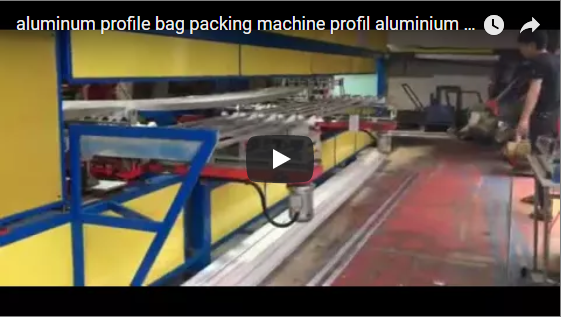
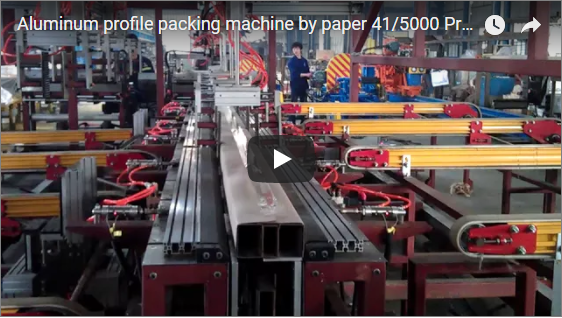
The line shown in the video is longer than the wrapping stage alone: profiles are fed in, wrapped, and carried out, with surrounding stations for bundling and stacking on site. The defining principle is that the profile stays straight while the film ring moves around it, so a long, thin bar is never twisted or dragged during wrapping.
| Fase | Función | Notas |
|---|---|---|
| Alimentación | Profiles enter on a roller conveyor | Bundle width and count per project |
| Anillo de envoltura | Film ring orbits the bundle, applying film in a spiral | Bar stays straight |
| Salida | Wrapped bundle leaves the station | Bundling or strapping on site |
Wrapping Geometry: Ring versus Spinning Profile
Long-profile wrapping machines use one of two geometries, and the choice matters for thin, scratch-sensitive aluminum bars.
| Nuevo enfoque | movimiento de carga | Beneficio típico | Restricción típica |
|---|---|---|---|
| Ring / orbital (shown) | Bar stays straight while the film ring orbits it | No surface drag; orientation preserved | Ring opening must clear the bundle |
| Spinning profile | Bar rotates around its long axis | Smaller machine footprint for short bars | Surface drag from rotation |
The ring style protects scratch-sensitive profiles by keeping the bar straight during wrapping. It also lets several long bars keep their orientation while the film is applied, which is the behavior buyers should look for when selecting a line for architectural or anodized profiles.
Qué verificar antes de comprar
The video shows the wrapping action, not the specification. No figure on screen states profile size, speed, film data, or capacity, so each numeric point must be confirmed per project. Start with the following:
| Pregunte al proveedor por | Por qué decide la compra |
|---|---|
| Min/max profile length, width, and weight | Whether the conveyor and ring hold your bars |
| Metres or profiles per hour at your size | Si la línea mantiene el ritmo de la producción |
| Film type, width, layers, and tension | The film is the protective layer |
| How the wrapping stage connects to infeed/outfeed | Ya sea que se ajuste a sus estaciones existentes |
| Confirmation of ring geometry (bar not spun) | Protects scratch-sensitive profiles |
| Dispositivos de seguridad y certificaciones | Guarding, emergency stops, and control safety |
On control-system and machinery safety, treat EN 415-10 and ISO 12100 as the safety references for packaging and conveying equipment, and ask the supplier which of these principles the delivered machine follows rather than assuming a per-machine certificate. As a stated manufacturer practice for this machinery family, each unit goes through sustained functional and safety testing before delivery (about 24 hours where stated), including the control system and the emergency-stop function; treat this as the stated family practice for acceptance planning and confirm the specific test record for your unit.
Preguntas Frecuentes
¿La etapa de envoltura modifica el perfil?
No. The video shows ring-style wrapping: the profile remains straight on the conveyor while the film ring runs around it, so the bar’s orientation does not change during wrapping.
¿Qué longitudes y tamaños de perfil acepta la línea?
The video does not show limits. Ask the supplier for the minimum and maximum profile length, width, and weight, and compare them against the bars you run.
Is this a full packaging line or only the wrapping stage?
The video shows the wrapping step of a larger line with adjacent stations on site. Ask how the wrapping stage is delivered and how it connects to your infeed and outfeed before committing.
Which wrapping geometry is best for my profiles?
Ring-style wrapping keeps the bar straight and avoids surface drag, which suits scratch-sensitive aluminum profiles. Confirm the offered geometry matches your surface requirements.
Próximo Paso
Send the supplier your profile lengths, widths, weights, and target wrapping speed, and ask for the verification figures in the table above. Confirm that the line uses ring-style wrapping that keeps the bar straight, then ask how the wrapping stage connects to your existing infeed and outfeed and what safety devices are supplied.