> **Συνοπτική παρουσίαση**
> How does a coil upender work? A hydraulic cylinder swings a heavy steel frame through 90° about a pivot on the base, so a coil that lies flat ends up standing on its edge, or the other way round. Our hydraulic upenders take 50–100 s for one tilt and are rated from 2 t up to 50 t. A worked example works out a coil's weight from its size and picks the right model.
Πίνακας περιεχομένων
- Why a coil has to change position
- The four main parts
- What happens during one tilt
- The machine shown
- Load ratings and tilt times
- Worked example: coil weight and model choice
- Three beginner mistakes
- Λίστα ελέγχου επιλογής: τι να μας στείλετε: τι να μας στείλετε
- Ασφάλεια και EN 415-10
- Συχνές ερωτήσεις μηχανικής
- Επόμενο βήμα
- Σχετική ανάγνωση
- Πηγές
Why a coil has to change position
A steel coil spends its life in two positions. It leaves the slitter or the rolling line with the eye horizontal, but it is often stored, packed or shipped with the eye vertical, lying flat on a pallet. Many payoff reels and decoilers need the eye horizontal again.
Turning a coil with a crane and chains means a load swinging in the air and edges that get crushed. An upender does the same turn on the floor, in a fixed path, with the coil held the whole time.
The four main parts
**Base.** A welded steel base sits on the floor and carries the pivot bearings. It takes the full coil weight and the reaction of the cylinder.
**Tilting frame.** An L-shaped or C-shaped frame holds the coil. One face carries the coil before the turn, the other after it. The frame swings about the pivot.
**Hydraulic cylinder and power unit.** A double-acting cylinder pushes the frame over and pulls it back. The power unit sets the oil flow, and the flow sets the tilting speed.
**Control panel.** An independent electrical panel or a pendant runs the up and down motions, with soft start and stop.
What happens during one tilt
1. A crane or forklift sets the coil on the loading face of the frame.
2. The operator starts the tilt. The cylinder extends, and the frame swings about the pivot.
3. Close to the end of travel the motion slows, so the coil does not hit the second face.
4. At 90° the coil rests on the second face, now turned. It is lifted off by crane, forklift or a coil car.
5. The frame swings back empty, ready for the next coil.
The hydraulic circuit keeps pressure on both sides of the cylinder. So the frame holds its position, with the load on it, if the operator stops halfway.
The machine shown
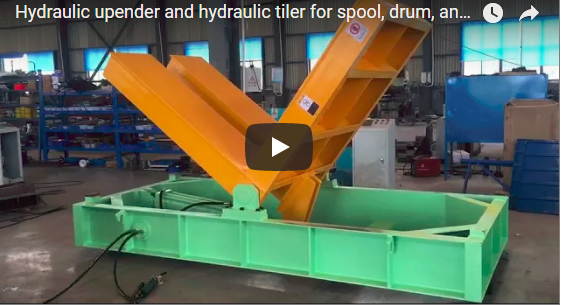
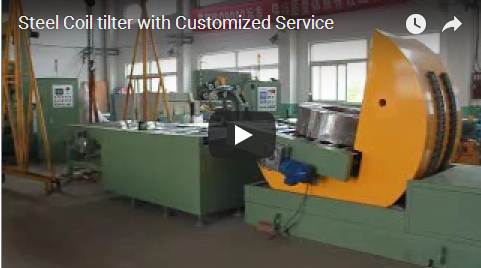
Our demonstration unit has a blue base and a yellow frame with a rounded back. Upper and lower plates close on the load, so it can also hold moulds and flat stacks. A coil-only upender usually has an open frame with a V-saddle instead of clamping plates. The operator runs it empty from a pendant, standing clear of the frame, and it swings through about 90° and back.
Load ratings and tilt times
| Model | Max load | Tilt time |
| :--- | :--- | :--- |
| FPCT-02 | 2 t | 50–70 s |
| FPCT-05 | 5 t | 50–80 s |
| FPCT-10 | 10 t | 60–90 s |
| FPCT-20 | 20 t | 60–90 s |
| FPCT-30 | 30 t | 60–90 s |
| FPCT-50 | 50 t | 60–100 s |
Across the range one tilt takes 50–100 s. Table size and machine size are designed to your coil. The supply voltage is built to order, and the warranty is 2 years.
For lighter coils we also build the FZ-H05 tilter. It takes loads of 1,000–5,000 kg with an OD of 1,000–1,800 mm and a length up to 2,000 mm. It tilts 90° on a 3.0 kW unit, with noise under 78 dB.
Worked example: coil weight and model choice
A plant upends steel coils of 1,200 mm OD, 508 mm ID and 600 mm width. These are illustrative customer figures.
**Coil weight.** The coil's cross-section is π ÷ 4 × (1.2² − 0.508²) = 0.928 m². Times the 0.6 m width it is 0.557 m³. At 7,850 kg/m³ the coil weighs 0.557 × 7,850 = 4,370 kg, or 4.4 t.
**First check.** 4.4 t is inside the FZ-H05's 1,000–5,000 kg, and the 1,200 mm OD is inside its 1,000–1,800 mm range. The FPCT-05 also fits.
**Wider coils.** The same plant also runs 1,000 mm wide coils. Their weight is 0.928 × 1.0 × 7,850 = 7,280 kg, or 7.3 t. That is over 5 t, so the plant needs an FPCT-10.
**Output.** One tilt on the FPCT-10 takes 60–90 s. So single strokes alone would limit it to 3,600 ÷ 90 = 40 or 3,600 ÷ 60 = 60 an hour. A full coil cycle also needs the empty return and the loading, so the real rate is 3,600 ÷ (T_up + T_back + t_load). Here t_load is your crane or forklift time.
Three beginner mistakes
**Sizing on the average coil.** Size the machine on the heaviest and widest coil you will ever run, not the usual one.
**Forgetting the centre of gravity.** A wide coil puts its weight further from the pivot. The turning moment is M = m × g × e, where e is that distance. Tell us the coil width so we can size the cylinder.
**No plan for unloading.** Decide first how the turned coil leaves the frame, by crane, forklift or coil car. That sets the frame shape and the floor height.
Λίστα ελέγχου επιλογής: τι να μας στείλετε: τι να μας στείλετε
1. Coil OD, ID and width, smallest and largest.
2. Heaviest coil weight.
3. Turn direction: eye horizontal to vertical, or both ways.
4. How coils come in and leave: crane, forklift or coil car.
5. Πηνία ανά ώρα.
6. Supply voltage and frequency.
Ασφάλεια και EN 415-10
For CE markets we follow EN 415-10 as the reference, with a risk assessment to ISO 12100. The main hazard is the swinging frame and the coil on it. Others are crush points between frame and base, and the hydraulic hoses.
Keep the operator outside the swing area, as on our demonstration unit, and fence the zone in a line. Our FZ-H05 is CE marked, and every upender has an emergency stop.
Συχνές ερωτήσεις μηχανικής
Q: Can the upender stop halfway?
A: Yes. The hydraulic circuit keeps pressure on the cylinder, so the frame holds the load at that point of the turn.
Q: Can it turn coils both ways?
A: Yes. The cylinder is double acting, so the frame turns from horizontal to vertical and back.
Q: Can one upender handle coils and moulds?
A: Yes, our tilters are built for coils, moulds, rod coils and dies. Tell us the heaviest load and its shape.
Q: Which standards do you build to?
A: EN 415-10 as our CE reference, with an ISO 12100 risk assessment.
Επόμενο βήμα
1. **Email your coil size, heaviest weight and coils per hour** to **info@fhopepack.com**.
2. **We reply within 24 hours with a proposal**, with the model, frame shape and loading method.
3. **We send a layout drawing** for your coil area.
Σχετική ανάγνωση
- [Hydraulic coil upender](https://www.fhopepack.com/Coil-Upender/Hydraulic-Coil-Upender.html)
- [Hydraulic tilter and upender](https://www.fhopepack.com/Hydraulic/hydraulic-tilter.html)
- [Coil tilter and coil upender](https://www.fhopepack.com/videos/coil-tilter-and-coil-upender/)
- [The 90-degree coil upender with rotary base](https://www.fhopepack.com/videos/the-90-degree-coil-upender-with-rotary-base/)
Πηγές
- Specifications: FHOPE hydraulic coil upender (FPCT series) and hydraulic tilter (FZ-H05) product pages
- Machine video: [hydraulic upender on YouTube](https://www.youtube.com/watch?v=f3b2xgwEYig)
- Coil weight and output: our worked example, illustrative coil figures
- Πρότυπα: EN 415-10 (μηχανές συσκευασίας, γενική ασφάλεια)· ISO 12100:2010
Τελευταία αξιολόγηση: 17-10-2026