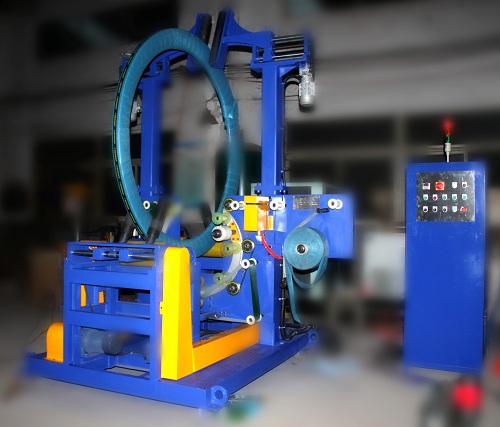
Executive summary What are the key considerations for choosing a horizontal wrapping machine? We check five things: the load's cross-section against the ring opening, its length and weight, the ring speed you need for your film overlap, the wrapping material and the level of automation. Our horizontal wrappers cover bundle sizes from 10 mm up to 400 mm OD. A worked example sizes a machine for a bundle of six tubes.
Inhaltsverzeichnis
- Wie ein horizontaler Orbital-Wrapper funktioniert
- 1. Cross-section and ring opening
- 2. Length, weight and conveyors
- 3. Ring speed, conveyor speed and overlap
- 4. Film and other wrapping materials
- 5. Semi-automatic or automatic
- Our models side by side
- Worked example: a bundle of six tubes
- Auswahlliste: Was Sie uns senden sollten
- Sicherheit und EN 415-10
- Häufig gestellte Fragen zur Technik
- Nächster Schritt
- Verwandte lesen
- Quellen
Wie ein horizontaler Orbital-Wrapper funktioniert
Long products such as tubes, profiles and bars cannot be turned like a pallet. So the load stays flat and moves through the machine on a conveyor, and a ring carrying the film roll turns around it. The film goes on as a spiral, and the conveyor speed sets how far the load moves for each turn of the ring.
Our demonstration machine wraps a bundle of six white tubes tied with a red strap. The bundle runs on a roller line through a yellow ring, and an operator guides the film at the start. This is the typical semi-automatic set-up for tube and profile bundles.
1. Cross-section and ring opening
Our model pages give the load size as a bundle OD. For a round load, that is its diameter. For a square or flat bundle, use the diagonal of the cross-section, because the corners pass closest to the ring.
Leave some margin under the top of the range. Straps, buckles and edge protectors add a few millimetres, and real bundles are rarely perfectly square.
2. Length, weight and conveyors
Each model has a minimum load length, because the load has to bridge the gap between the infeed and outfeed conveyors through the ring. On our S200 it is above 300 mm; on the E400 it is above 1,200 mm.
The standard conveyors are 1,000 mm or 2,000 mm long with motor drive. A 6 m bundle overhangs a 2 m conveyor, so for long loads we add conveyor length or extra roller supports. The S200 takes 10–100 kg and the E300 and E400 15–100 kg.
3. Ring speed, conveyor speed and overlap
This is where most selection mistakes happen. For one turn of the ring, the load moves forward by the pitch p = v ÷ n, where v is the conveyor speed and n the ring speed.
With film width W, the overlap is 1 − p ÷ W. So for a set overlap you need p = W × (1 − overlap), and the ring has to turn at n = v ÷ p. If n comes out above the model's top ring speed, you must slow the conveyor down.
4. Film and other wrapping materials
The S200 runs LLDPE stretch film 120–200 mm wide on a 50 mm core. The E400 also takes paper, PP and woven tape, on 50 or 76 mm cores. Paper or woven tape is the choice when the surface must breathe or must not touch plastic.
A wider film needs fewer ring turns for the same overlap, so you can run the conveyor faster. A narrower film follows small or tapered loads better.
5. Semi-automatic or automatic
On a semi-automatic machine the operator loads the bundle and starts the film. Our S200 has a PLC and HMI, a photocell to find the load, alarms and guardrails, and it can be linked to a production line. An automatic film cutter is an option.
The S300 adds automatic film clamping and cutting. The E-series machines set head and end delays and extra reinforcing turns at both ends on the touch screen, for unattended running in a line.
Our models side by side
| Modell | Bündel-OD | Länge | Fördergeschwindigkeit | Ringgeschwindigkeit | Tuning |
|---|---|---|---|---|---|
| S200 | 10 – 200 mm | > 300 mm | 4–12 m/Min | 20–120 U/min | ca. 2.1 kW |
| Economic orbital wrapper | 50 – 200 mm | > 1,500 mm | 4–15 m/Min | 20–100 U/min | ca. 1.5 kW |
| S300 | 50 – 300 mm | > 1,000 mm | not listed, set per line | 100 r / min | ca. 1.5 kW |
| 300 | 50–300 mm* | > 1,000 mm | 6–12 m/Min | 20–90 U/min | ca. 2.5 kW |
| 400 | 100 – 400 mm | > 1,200 mm | 6–12 m/Min | 20–90 U/min | ca. 2.5 kW |
*50 mm is for stiff products. Soft or flexible loads can bend in the ring and need about 100 mm, so we judge the minimum from your actual product. All run on 380 V, 60 Hz. Larger openings come in our E-series up to the E2400.
Worked example: a bundle of six tubes
A plant packs bundles of six round tubes, 50 mm OD and 6,000 mm long, in two rows of three. Each tube weighs about 8 kg. It wants 150 mm film at 50% overlap. These are illustrative customer figures.
Cross-section. The bundle is 150 mm wide and 100 mm high. Its diagonal is √(150² + 100²) = 180 mm. That fits the S200 and the economic wrapper with 20 mm to spare, or the S300 and E300 with more room.
Weight and length. The bundle weighs 6 × 8 = 48 kg, inside 10–100 kg. At 6,000 mm it is far above every minimum length, but it overhangs 2,000 mm conveyors, so we would add supports.
Ring speed. The pitch is p = 150 × (1 − 0.5) = 75 mm per turn. On the S200 at 4 m/min, n = 4,000 ÷ 75 = 53 r/min. At 12 m/min it would need 160 r/min, above the 120 r/min top speed. So the fastest conveyor speed at 50% overlap is 120 × 0.075 = 9 m/min.
Feierabend. At 9 m/min the 6 m bundle passes in 6 ÷ 9 × 60 = 40 s. On an E300 the ring tops out at 90 r/min, so the limit is 90 × 0.075 = 6.75 m/min, or about 53 s.
Film. The ring makes 6,000 ÷ 75 = 80 turns. The film path round the bundle is about 2 × (100 + 50) + π × 50 = 457 mm. So one bundle takes about 80 × 0.457 = 37 m of film on the load, with the 50% overlap already counted. The roll pays out less than that, because the film is stretched as it goes on.
Ergebnis. For an operator-loaded line, the S200 does this bundle in about 40 s of wrapping. If the bundles may grow past 200 mm diagonal, we would offer the S300 or E300 instead.
Auswahlliste: Was Sie uns senden sollten
- Load cross-section: width, height or OD, and the largest size you may run.
- Length range and weight per bundle.
- Bundles per hour or per shift.
- Wrapping material, film width and overlap.
- Manual loading or connection to your production line.
- Versorgungsspannung und -frequenz.
Sicherheit und EN 415-10
For CE markets we follow EN 415-10 as the reference, with a risk assessment to ISO 12100. The main hazard is the turning ring and film carriage. The infeed and outfeed conveyors and the film cutter are the others.
The S200 comes with guardrails, and the ring has a soft start and stop. Keep the operator outside the ring zone while it turns, and stop the machine before threading film or clearing a jam.
Häufig gestellte Fragen zur Technik
Q: Can one machine wrap several bundle sizes? A: Yes, within its OD range. On the S200, guide boards move up and down to centre bundles of different OD.
Q: How do we change the overlap? A: Ring speed is set by the inverter, and the overlap rate is adjustable. The formula above shows how ring and conveyor speed must move together.
Q: Can we wrap with paper instead of film? A: Yes, on models that take paper, PP or woven tape, such as the E400. Tell us the material width and core size.
F: Nach welchen Normen bauen Sie? A: EN 415-10 als unsere CE-Referenz, mit einer Risikobewertung nach ISO 12100.
Nächster Schritt
- Email your bundle size, length, weight and output zu info@fhopepack.com.
- Wir antworten Ihnen innerhalb von 24 Stunden mit einem Angebot., with the model, ring speed and conveyor layout.
- Wir senden eine Layoutzeichnung for your packing area.
Verwandte lesen
- Halbautomatische horizontale Orbitalwickelmaschine S200
- E300 horizontale Stretchfolie
- Horizontale Orbitalwickelmaschine für Stahlrohre
- Orbital-Stretchwickler aus Aluminium
- Automatische horizontale Wickelmaschine und Orbitalwickelmaschine
Quellen
- Specifications: FHOPE S200, S300, economic orbital wrapper, E300 and E400 product pages
- Maschinenvideo: horizontal wrapping of a tube bundle on YouTube
- Overlap, ring speed and film use: our worked example, illustrative bundle figures
- Normen: EN 415-10 (Verpackungsmaschinen, allgemeine Sicherheit); ISO 12100:2010
Letzte Überprüfung: 21.09.2026