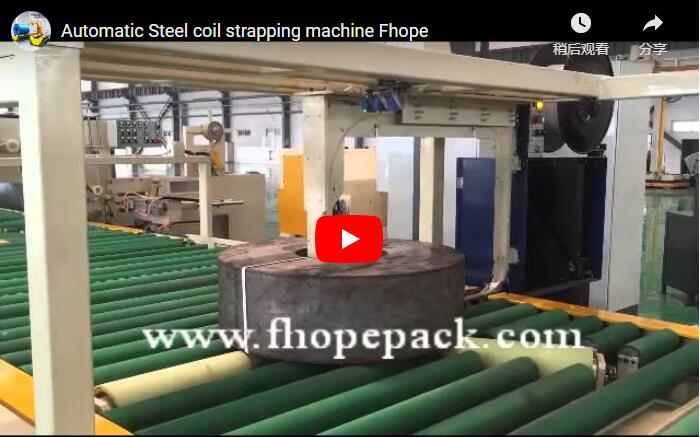
Executive summary In this 22 s clip a stack of steel sheet runs on a powered roller conveyor through our strapping arch. The yellow strapping head on the arch beam bands the stack with steel strap fed from the large yellow reel beside the machine, and the operator watches from the control cabinet. Below we explain the cycle, our steel-strap data (strap tension 7,000–18,000 N), and how to work out band length and band spacing for a plate stack.
Inhaltsverzeichnis
- Was der Clip zeigt
- Why steel strap for sheet stacks
- Steel strap data
- Strap use and band spacing
- Auswahl-Checkliste
- Sicherheit
- Häufig gestellte Fragen zur Technik
- Nächster Schritt
- Verwandte lesen
- Quellen
Was der Clip zeigt
| Teil | Was Sie sehen |
|---|---|
| Maschinen und Technologie | A blue arch frame across the roller conveyor, with a yellow beam carrying the strapping head |
| Gurtversorgung | A large yellow strap reel on the left feeds steel strap to the head |
| Stapeln | A flat stack of steel sheet on the powered roller conveyor, moving slowly into the arch |
| Strapping | The head on the beam works across the stack while the strap is laid round it |
| Kontrolle | A white control cabinet on the right; the operator stands beside it |
The clip runs 22 s. The conveyor brings the stack into the arch, and the head bands it at the set band positions; the head has to tension, seal and cut each band before the stack moves on.
Why steel strap for sheet stacks
- Scharfe Kanten. Cut sheet edges can cut plastic strap; steel strap holds.
- High tension. A heavy plate stack needs high band tension to stop sheets sliding when lifted.
- Low stretch. Steel strap keeps its tension in transit and storage.
- Heat and weather. Steel strap does not soften in hot holds or yards.
Steel strap data
Our published data for our hydraulic steel strapping head:
| Artikel | Veröffentlichter Wert |
|---|---|
| Bügelmaterial | Kaltgewalzter, kohlenstoffarmer Stahl, brüniert und gewachst |
| Riemendicke | 0.8 mm oder 1.0 mm |
| Siegelbreite | 25 mm oder 32 mm |
| Riemenspannung | 7,000–18,000 N |
| Futteraufnahme und -verwertung | 2–3 m/s |
| Spannungsgeschwindigkeit | 6 m / min |
| Hydraulischer Druck | 100 bar (Arbeitsdruck 80–90 bar) |
| Seal Magazin | Etwa 180 Robben |
The arch width, conveyor and number of bands are built to your stack sizes.
Strap use and band spacing
A band round a flat stack needs about 2 × (W + H), where W is stack width and H stack height, plus the seal overlap.
Durchgerechnetes Beispiel (zur Veranschaulichung). A stack 1,500 mm wide and 200 mm high needs 2 × (1,500 + 200) = 3,400 mm of strap per band, before the seal overlap. On a stack 3,000 mm long with 300 mm left at each end and 3 bands, the spacing is (3,000 − 600) ÷ 2 = 1,200 mm. Three bands use about 10.2 m of strap, plus three seal overlaps.
Auswahl-Checkliste
- Blechdicke, Breite und Längenbereich.
- Stapelhöhe und Gewicht.
- Bands per stack and their positions.
- Strap thickness and seal width you buy today.
- Edge protectors under the strap, if needed.
- Stapel pro Stunde.
- Conveyor link to the cut-to-length line and the lifting area.
Sicherheit
The strap is tensioned up to 18,000 N and the stack moves on powered rollers. In the clip the operator stands at the control cabinet, outside the strap path. On a production line we guard the arch and conveyor zone to the risk assessment, so nobody reaches the head or the moving stack while the machine runs. Hydraulic work is done with the system stopped and pressure released.
Für CE-Märkte wenden wir ISO 12100 für die Risikobewertung und EN 415-10 für allgemeine Anforderungen an Verpackungsmaschinen an.
Häufig gestellte Fragen zur Technik
Q: Why steel strap and not plastic for sheet stacks? A: Steel strap resists cutting by sharp plate edges and holds a tension of up to 18,000 N on a heavy stack.
Q: How tight is the band? A: Our hydraulic steel strapping head is set within 7,000–18,000 N.
Q: What strap does it use? A: Cold-rolled low-carbon steel strap, 0.8 mm or 1.0 mm thick, with 25 mm or 32 mm seals.
Q: How much strap per band? A: About 2 × (W + H); a stack 1,500 mm wide and 200 mm high needs about 3,400 mm.
Q: Does the stack stop for strapping? A: The stack runs on the powered conveyor and is positioned at each band point; band positions are set to the stack length.
Q: What hydraulic pressure does the head use? A: The system is rated at 100 bar, with a work pressure of 80–90 bar.
Q: How many seals does the magazine hold? A: About 180 seals, so the operator refills it after about 180 bands.
F: Welche Normen gelten? A: Für CE-Märkte gelten ISO 12100 und EN 415-10.
Nächster Schritt
We size a sheet strapping machine in three steps:
- Reichen Sie Ihre Layoutzeichnung ein. with sheet and stack sizes, weight, bands per stack and stacks per hour, to info@fhopepack.com.
- Sie erhalten innerhalb von 48 Stunden ein Angebot. mit Angaben zur Fußgewölbegröße und zum Riemen.
- Buchen Sie eine Standortbesichtigung Wir bestätigen also die Bodenfläche und die Förderbandverbindungen.
Verwandte lesen
- Verpackungslinie für Stahlbleche (Zuschnitte)
- Automatische Stahlblech-Umreifungsmaschine
- Stahlbandumreifung: Auswahl des Umreifungsmusters
- Stahlblechwender für sicheres Drehen um 180 Grad
- Daten der Stahlbandumreifungsmaschine
Quellen
- Maschine im Einsatz (unsere Aufnahmen): das Video auf YouTube
- Stahlband, Dichtung, Spannung, Geschwindigkeit und Hydraulikdaten: Daten der Stahlbandumreifungsmaschine
- Band length and spacing: our worked geometry
- Geltungsbereich der Normen: ISO 12100:2010; EN 415-10: 2014
- Frist für die Angebotsabgabe: Genehmigtes Haus CTA (Angebot innerhalb von 48 Stunden)
Letzte Überprüfung: 21.09.2026