Executive summary Choose a wire coil wrapping machine by checking four coil figures against each model: inside diameter, outside diameter, width and weight. Our FPW range runs from the FPW-300 for light coils up to 250 kg to the FPW-800 for coils up to 3,000 kg. Loading method decides between models that overlap on size. A worked example selects a model and checks that the tape still covers the outside of the coil.
Inhaltsverzeichnis
- How an eye-through ring wrapper covers a coil
- The four coil figures that decide the model
- FPW model range
- Loading method: the tie-breaker
- Worked example: picking a model and checking coverage
- Packing material and roll size
- Auswahlliste: Was Sie uns senden sollten
- Sicherheit und EN 415-10
- Häufig gestellte Fragen zur Technik
- Nächster Schritt
- Verwandte lesen
- Quellen
How an eye-through ring wrapper covers a coil
A steel wire coil is a thick ring. To seal it against dust and moisture, the tape has to pass through the eye and round the outside, over and over, as the coil turns. Our FPW machines do this with an opening ring that carries the tape roll and threads through the coil eye.
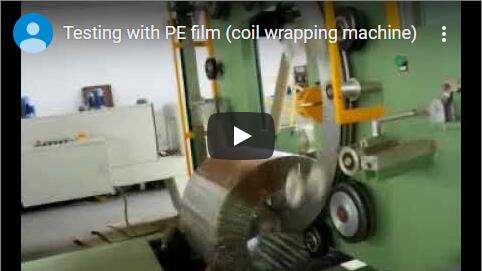
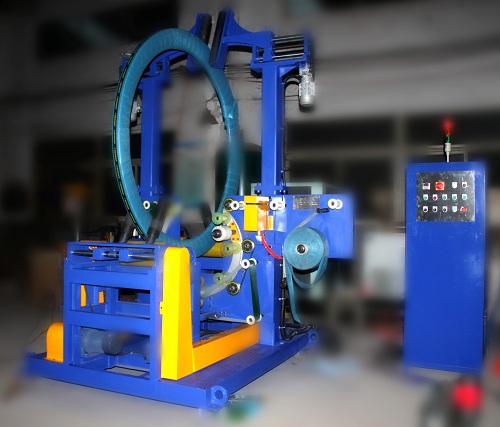
While the ring turns, rollers under the coil rotate it slowly, so each tape pass lands beside the last. The compact machine here wraps a small coil in green tape behind a yellow mesh guard. The operator ties the tape on, presses start and the machine lays it round the whole coil.
The four coil figures that decide the model
Inside diameter (ID). The ring has to pass through the eye, so the ID sets the smallest coil a model can take.
Außendurchmesser (AD). The OD sets the ring size and the height the rollers or main board must reach.
Breite. This is the coil's height when it stands on edge. It sets how far the ring has to open.
Gewicht. The weight decides how strong the rollers and drive are, and how the coil gets on and off the machine.
FPW model range
| Modell | Spule ID | Spule OD | Spulenbreite | Coilgewicht | Tuning |
|---|---|---|---|---|---|
| FPW-300 | 300 – 700 mm | 450 – 850 mm | 100 – 300 mm | 10-250 kg | 1.5 kW |
| FPW-400 | über 300 mm | 600 – 1,200 mm | 40 – 400 mm | 40-400 kg | 1.5 kW |
| FPW-500 | 300 – 700 mm | 700 – 1,300 mm | 50 – 500 mm | 40-1,500 kg | 3.5 kW |
| FPW-600 | 300 – 850 mm | 700 – 1,400 mm | 150 – 600 mm | 100-4,000 kg | 4.5 kW |
| FPW-800 | über 500 mm | 800 – 1,400 mm | 300 – 800 mm | 200-3,000 kg | 3.4 kW |
All five run on 380 V, 50 Hz, 3 phase, with an adjustable overlap of 10%–90%. We also design to your specification outside these ranges.
Loading method: the tie-breaker
Coil sizes overlap between models, so the way the coil arrives often decides.
- FPW-300: you roll the coil on and off by hand, tie the tape on and cut it by hand. A PLC with time relay runs the wrap.
- FPW-400: a low table for loading at floor level. PLC and HMI, automatic start and stop, automatic cutting and PU-covered rollers.
- FPW-500: an automatic trolley moves the coil in and out. A mechanical hand feeds and cuts the tape, and a geared motor sets the main board height.
- FPW-600: for heavy, large coils, with floor-level, trolley or crane loading agreed with your team.
- FPW-800: a crane sets the coil down and it stays still. The machine travels on floor rails between packing stations.
Worked example: picking a model and checking coverage
Take a galvanised wire coil 900 mm OD, 500 mm ID and 200 mm wide, weighing 250 kg. The plant loads from the floor. These are illustrative customer figures.
Modell. The FPW-300 tops out at 850 mm OD, so it is out. The FPW-800 needs at least 300 mm width, so it is out too. The FPW-400, FPW-500 and FPW-600 all fit. With floor loading and no trolley, the FPW-400 is the match.
Turns needed at the eye. With 100 mm tape at 50% overlap, each pass advances 50 mm at the eye. The eye circumference is π × 500 = 1,571 mm, so the wrap needs 1,571 ÷ 50 = 31.4, or 32 passes.
Coverage at the outside. The same 32 passes spread round π × 900 = 2,827 mm. That puts them 2,827 ÷ 32 = 88 mm apart, under the 100 mm tape width, so the outside is still covered with about 12% overlap.
Tape used. One pass goes round the coil section, which is the width plus the radial thickness, twice. The radial thickness is (900 − 500) ÷ 2 = 200 mm, so one pass is 2 × (200 + 200) = 800 mm. 32 passes use about 32 × 0.8 = 25.6 m of tape, before stretch.
Feierabend. You set the ring speed on the HMI for your coil and material. With n ring passes per minute, the wrap takes N ÷ n minutes, so 32 passes take 32 ÷ n. Add your own loading and unloading time to get coils per hour.
When the outside opens up. Now take a coil 850 mm OD and 300 mm ID, set to 30% overlap. The eye needs π × 300 ÷ 70 = 13.5, so 14 passes. At the outside those are π × 850 ÷ 14 = 191 mm apart, wider than the tape.
The rule is to set the passes from the outside: N ≥ π × OD ÷ tape width. Here that gives π × 850 ÷ 100 = 26.7, or 27 passes, and the eye gets heavy overlap.
Packing material and roll size
The range takes PVC, LLDPE, PE, paper and HDPE. All models use a 50 mm roll core.
| Modell | Roll OD | Rollenbreite |
|---|---|---|
| FPW-300 | 100 – 250 mm | 100 – 120 mm |
| FPW-400 | 100 – 250 mm | 100 – 300 mm |
| FPW-500 | 100 – 450 mm | 100 – 120 mm |
| FPW-600 | 200 – 450 mm | bis zu 120 mm |
| FPW-800 | 100 – 250 mm | 100 – 300 mm |
A larger roll means fewer changes on a busy shift. A brake on the roll sets the tape tension, and the FPW-400, FPW-600 and FPW-800 need a 4–6 bar air supply.
Auswahlliste: Was Sie uns senden sollten
- Spulen-Innendurchmesser, Außendurchmesser und Breite, kleinste und größte Größe.
- Schwerstes und leichtestes Spulengewicht.
- Wire type and surface: black, galvanised, coated or copper.
- Packing material and the protection you need for shipping.
- How coils arrive and leave: by hand, trolley, conveyor or crane.
- Spulen pro Schicht.
Sicherheit und EN 415-10
We build our wire coil wrappers to CE requirements, with EN 415-10 as the reference and an ISO 12100 risk assessment. The main hazards are the turning ring, which passes through the coil eye, and the rotating coil on its rollers.
Guardrails enclose the ring, and soft start and stop limit sudden movement. Fault alarms show on the panel. On the FPW-800, an interlock with fence, or a light beam with fence, is available.
Häufig gestellte Fragen zur Technik
Q: My coils vary in size. Does each size need its own machine? A: No. Coil sizes are entered in the control system, and the ring height adjusts for different OD. Pick the model that covers your smallest and largest coil.
Q: Will the rollers mark a coated wire? A: The FPW-400 and FPW-500 rollers and contact points are PU covered to protect the wire surface.
Q: Can the tape be fed and cut automatically? A: Yes, on the FPW-400 and up. On the FPW-300, the tape is tied on and cut by hand.
F: Welche Sicherheitsstandards gelten? A: Für CE-Märkte arbeiten wir nach EN 415-10 mit einer Risikobewertung nach ISO 12100.
Nächster Schritt
- Email your coil ID, OD, width and weight range zu info@fhopepack.com.
- Wir antworten Ihnen innerhalb von 24 Stunden mit einem Angebot., naming the model and loading method.
- Wir senden eine Layoutzeichnung mit der Ein- und Auslaufseite.
Verwandte lesen
- Drahtspulenwickelmaschinen
- Drahtspulenwickelmaschine FPW-400
- Drahtspulenwickelmaschine FPW-800
- Schlauchwickel-, Kabelwickel- und Palettenwickelmaschine
- Wickelmaschine und Verpackungsmaschine für Stahldrahtspulen
- Kabelspulen-Verpackungsmaschine und Draht-Verpackungsmaschine
Quellen
- Specifications: FHOPE FPW-300, FPW-400, FPW-500, FPW-600 and FPW-800 product pages
- Maschinenvideo: wire coil wrapping on YouTube
- Model choice, passes and tape use: our worked example, illustrative coil figures
- Normen: EN 415-10 (Verpackungsmaschinen, allgemeine Sicherheit); ISO 12100:2010
Letzte Überprüfung: 21.09.2026