Executive summary Corrugated hose coils inherently possess stored spring-back tension that causes individual coil turns to wander, telescope, or unravel during handling. Without dynamic vertical stabilization, the hoop tension of applied stretch film pulls outer loops out of alignment rather than securing them. The horizontal orbital wrapping system detailed in this guide stabilizes the flexible corrugated hose coil inside a dedicated rotating cradle, applies adjustable pneumatic down-force via dual non-marking polyurethane press rollers, and spirals high-stretch PE/LLDPE film through the coil core. Precise wrap pass counts and structural containment derive mathematically from coil outer diameter (OD), core height, and a minimum target film overlap ratio calibrated for inter-turn structural rigidity.
Inhaltsverzeichnis
- Was das Video zeigt
- So funktioniert die Schlauchwickelvorrichtung
- Wickelvorgänge und Folienüberlappung pro Spule
- Was Sie uns über Ihren Schlauch erzählen sollten
- Kontrollen und Sicherheit
- Auswahlliste für eine Schlauchwickelmaschine
- Häufig gestellte Fragen zur Technik
- Nächster Schritt
- Verwandte lesen
- Quellen
Was das Video zeigt
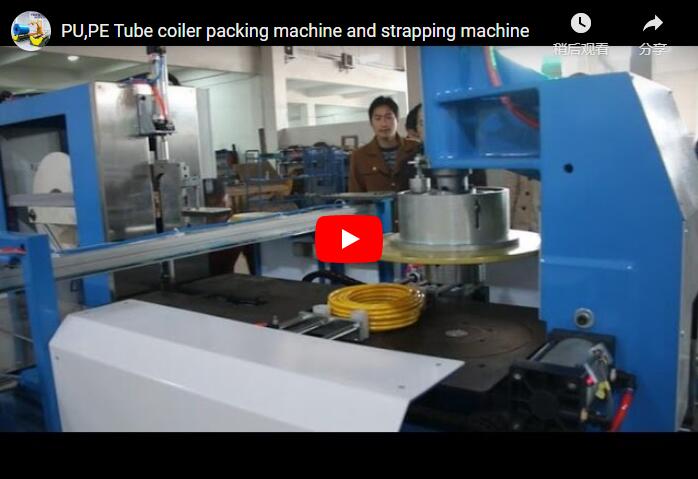
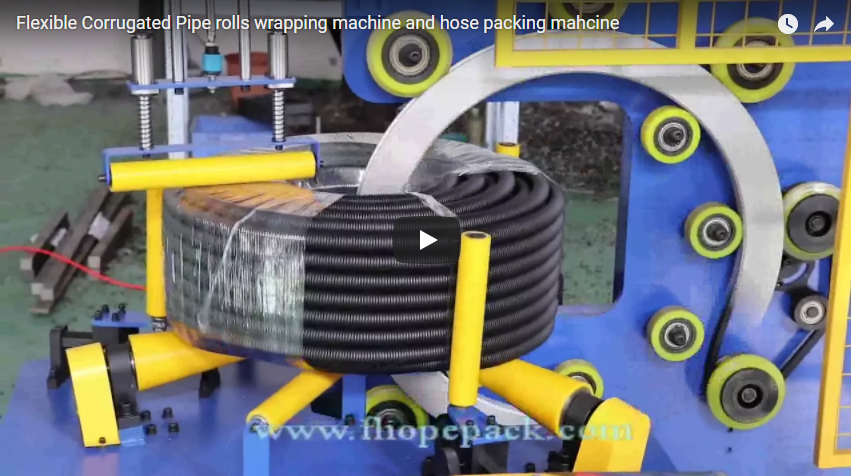
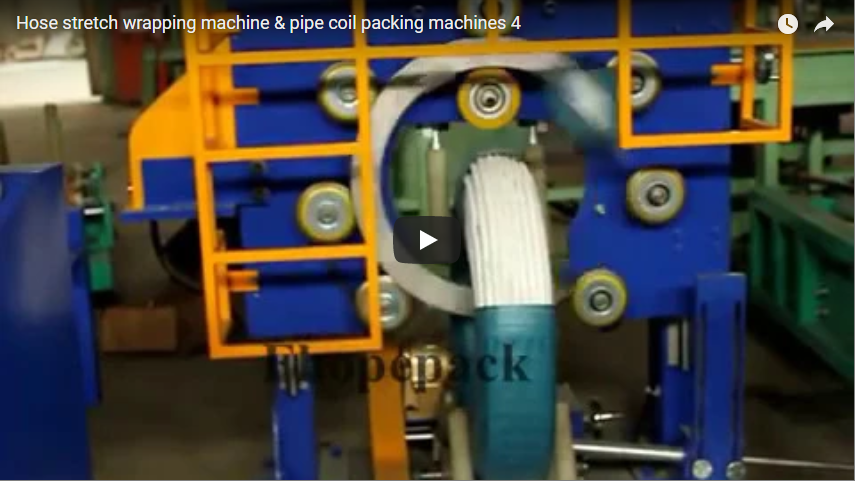
The operational sequence illustrates continuous dynamic containment and orbital film application on a loose-wound, black corrugated plastic hose coil. Upon mechanical positioning inside the wrapping station, an overhead dual-roller stabilizer descends under controlled pneumatic pressure to capture the coil crown. This holds the elastic loops co-planar without deforming the hollow corrugated crests.
Once top pressure is registered, the synchronized bottom driven cradle rollers rotate the coil around its horizontal centerline. Concurrently, the orbital rotating shuttle delivers cast LLDPE stretch film through the coil inner diameter (ID) and across the outer diameter (OD) in a high-speed helical path.
Adjustable lateral guide rollers maintain continuous coil centering against centrifugal displacement throughout the entire orbital cycle. Once programmed layer overlap is achieved, the overhead press cylinder retracts to home position, clearing the wrapped package for extraction.
So funktioniert die Schlauchwickelvorrichtung
| Schritt | Mechanical Mechanism | Process Engineering Objective |
|---|---|---|
| 1. Laden | Dual horizontal drive cradle rollers | Supports the coiled package concentrically within the orbital ring clearance zone. |
| 2. Stabilisieren | Pneumatic top press unit with dual PU rollers | Counteracts axial spring-back tension (0.2–0.6 MPa variable down-force) to maintain package flatness without crushing corrugated walls. |
| 3. Zentrieren | Lateral polyurethane guide rollers | Prevents radial runout and lateral migration induced by wrap film tension. |
| 4. Orbital Wrap | High-speed orbital rotary ring & tension film carriage | Feeds stretch film through the coil center; film tension creates inward hoop compression while the cradle advances rotation. |
| 5. Freisetzung | Guided cylinder lift with safety interlock | Relieves top clamping force smoothly, allowing the coil to retain its compacted cylindrical geometry. |
| 6. entladen | Gravity discharge ramp / manual lift-off | Transfers the unitized coil directly to strapping or palletizing stages. |
The synchronized roller press counteracts coil telescoping before the orbital ring rotates. For rigid smooth-wall piping that demands different roller friction coefficients, consult our specialized HDPE-Rohrspulen- und Schlauchwickelmaschine; for continuous bundling and horizontal push-through mechanisms, review our Horizontale Ring-Orbital-Stretchwickelmaschine.
Wickelvorgänge und Folienüberlappung pro Spule
Total orbital ring revolutions (wrap passes) are dictated by coil circumference at the outer diameter and effective linear film advance per coil turn. Because linear surface velocity is highest at the coil OD, overlap must be calibrated for the outer circumference; the inner diameter (ID) naturally receives denser, self-locking film concentration.
Ausgearbeitetes Ingenieurbeispiel:
- Außendurchmesser der Spule (OD): 1,000 mm
- Coil Outer Circumference (C_od): π × OD = 3.1416 × 1,000 mm = 3,142 mm
- Usable Film Web Width (W): 100 mm
- Target Minimum Overlap Ratio at OD: 50 %
- Effective Linear Pitch Advance per Turn (P): W × (1 – 0.50) = 50 mm advance
- Required Full-Coverage Ring Passes (N):
N = C_od ÷ P = 3,142 mm ÷ 50 mm = 62.84- Aufrunden auf 63 Umdrehungen Minimum.
| Prozessvariable | Formula / Engineering Baseline | Parameter for 1,000 mm OD Coil |
|---|---|---|
| Outer Circumference (C_od) | π × Coil OD | 3,142mm |
| Film Width (W) | Standard packaging roll width | 100mm |
| Overlap Ratio at OD (η) | Target weather-tight/containment overlap | 50% |
| Effective Pitch Advance (P) | W × (1 – η) | 50 mm per cycle |
| Calculated Passes (N) | C_od ÷ P (rounded up) | 63 besteht |
| Target Ring Speed | Inverter-controlled orbital shuttle | 60–90 U/min |
| Netto-Verpackungszykluszeit | (N ÷ Ring RPM) × 60 + index dwell | 48 – 65 Sekunden |
Film delivery systems incorporate mechanical friction or pre-stretch core brakes (typically set between 15 N and 35 N tension), ensuring the film contracts tightly across the outer ridges without collapsing flexible hose profiles.
Was Sie uns über Ihren Schlauch erzählen sollten
To ensure the rotating ring inner diameter, carriage clearances, and roller durometers match your exact product line, provide the technical parameters detailed below:
| Produktionsparameter | Engineering Impact on Machine Sizing | Design Boundary Considerations |
|---|---|---|
| Hose Outer Diameter & Profile | Determines press roller material, durometer, and downward pressure limits. | Deep-corrugated thin-wall PVC/PE requires wide-face soft rollers (Shore A 60) to prevent rib deformation. |
| Coil Dimensions (OD × ID × Height) | Governs orbital ring inner diameter (Clear Ring ID) and drive cradle roller center-to-center span. | The ring opening must clear: √[(Coil Height)² + (Coil Wall Thickness)²] + Carriage Clearance (≥ 150 mm). |
| Coil Weight & Packaging Mass | Sizes the cradle drive motor wattage, reducer ratio, and shaft bearing load ratings. | High-mass coils (e.g., steel-wire reinforced rubber hose) necessitate heavy-duty vulcanized steel rollers. |
| Output Target (Coils per Hour) | Dictates ring rotational RPM, automated cut-and-clamp integration, and cycle overlap programming. | Manual cutting fits 20–30 coils/h; auto mechanical wipe-and-cut units achieve 45–60 coils/h. |
| Film Material Specification | Establishes carriage tensioner configuration and pre-stretch ratio (up to 200%). | 20–35 µm cast LLDPE stretch film, colored UV-stabilized barrier films, or VCI anti-corrosion films. |
| Labeling Sequence | Identifies placement of downstream barcoding or under-film flag labels. | Barcode tags are affixed prior to final wrap layer for dust-proof optical scanning. |
Kontrollen und Sicherheit
Orbital wrapping systems combine rotational torque with vertical pneumatic motion. Machine safety configurations must adhere strictly to international safety standards governing packaging machinery:
- Standardkonformität: Systems manufactured for the European Economic Area conform to ISO 12100:2010 (Risikobewertung und -minderung) und EN 415-10: 2014 (Sicherheitsanforderungen für Verpackungsmaschinen).
- Guarding & Optical Curtains: Integrated front load zones utilize Category 4 / Performance Level d (PL d) safety light curtains or perimeter interlocked safety mesh cages (ISO 14120). Breaking the beam interrupts the drive circuit instantly via an approved safety relay.
- Pneumatic Down-Drop Prevention: Top press cylinders incorporate pilot-operated check valves (anti-fall safety valves) that prevent the roller assembly from dropping in the event of sudden compressed air loss.
- Kontrollarchitektur: Industrial PLC platform with an intuitive HMI touch panel permits fine adjustments of ring rotational speed, cradle drive acceleration ramps, and wrap layer overlaps with lockable access control.
Auswahlliste für eine Schlauchwickelmaschine
Use this mechanical checklist when auditing your packaging line for automated orbital wrapper integration:
- Spulen-Dimensionshülle: Maximum Coil OD, Minimum Coil ID, and Maximum Axial Coil Height recorded.
- Hose Mechanical Properties: Hose wall structure, rib stiffness rating, and sensitivity to surface indentation.
- Durchsatzrate: Required packaged coils per hour at peak shift capacity.
- Verpackungsmaterialspezifikation: Film roll width (75–150 mm), core diameter (50–76 mm), film thickness (µm), and pre-stretch capability.
- Loading Mechanics: Manual front loading, overhead crane feed, or continuous conveyor roll-in integration.
- Facility Utility Access: 3-Phase Electrical Supply (380V/480V, 50/60 Hz) and clean, dry industrial compressed air (0.5–0.7 MPa).
Häufig gestellte Fragen zur Technik
Q: Why is an overhead vertical press unit mandatory for corrugated hose coils? A: Corrugated plastic and reinforced rubber hoses store bending strain when coiled. This radial elastic energy continuously forces the inner and outer turns out of vertical plane. A non-marking overhead press roller system restrains this spring-back force, locking coil faces parallel so stretch film binds the package into a rigid, self-supporting cylindrical package.
Q: How do you prevent thin-wall corrugated ribs from crushing under wrap tension? A: Crushing is prevented through a dual-mechanism control system: first, the overhead press uses an independent precision pneumatic regulator setting minimal clamping force (typically 0.2–0.4 MPa); second, the orbital film carriage employs an adjustable mechanical friction brake that limits film pull tension to between 15 N and 25 N, achieving film stretch through elongation rather than high radial pressure.
Q: Where should the baseline overlap percentage be calibrated on circular coils? A: Wrap overlap must always be calibrated at the outermost diameter (OD). Because linear surface travel speed is maximum at the outer rim, setting a 50% overlap at the OD ensures complete surface coverage across the perimeter; the inner diameter (ID) automatically receives a denser, multi-ply overlapping pattern.
Q: How is the required orbital ring inner diameter (ID) determined for a machine?
A: The ring clearance must exceed the coil’s cross-sectional diagonal plus the dynamic radial swing clearance of the orbital film carriage. The basic engineering constraint is: Ring_ID ≥ √[(Coil_Width)² + (Coil_Height)²] + 2 × Clearance_Margin (where clearance margin is normally ≥ 150 mm).
Q: Can this equipment accommodate varying coil diameters without mechanical changeover? A: Yes. The cradle drive rollers and pneumatic overhead press stroke accommodate continuous OD/height variations within the engineered range. Operators select predefined coil recipe presets on the HMI screen to adjust cradle rotation speed and overlapping parameters automatically without physical tooling changes.
Nächster Schritt
Streamline your hose packaging operations with a custom-engineered wrapping cell:
- Produktdaten einreichen: Send your coil envelope dimensions (Min/Max OD, ID, and Coil Height), product weight, and target output to info@fhopepack.com.
- Sie erhalten innerhalb von 48 Stunden ein technisches Angebot.: Our design office will deliver an equipment footprint proposal, including calculated wrap cycle times, film consumption estimates, and mechanical layouts.
- Verify Line Integration: Coordinate with our project engineering team to evaluate factory floor clearances, electrical bus ratings, and upstream coiler-to-wrapper transfer mechanisms.
Verwandte lesen
- Pipe Packing Machines – Heavy-Duty Automatic Packaging Solutions
- Video Demonstration: Flexible Corrugated Pipe Rolls Wrapping Machine
- Video Demonstration: Double Wall Corrugated Hose Coiling and Strapping Machine
Quellen
- Technical Equipment Specifications: FHOPE Engineering Technical Department, 2026-10-04
- Overlap & Kinematic Formulations: FHOPE Packaging Systems Standard Design Manual
- Machine Video Demonstration: Official FHOPE Machine Archive on YouTube
- Safety & Machinery Directives: ISO 12100:2010 Sicherheit von Maschinen, EN 415-10:2014 Sicherheit von Verpackungsmaschinen
Letzte Überprüfung: 21.09.2026