Executive summary
An automatic tape binding machine wraps adhesive tape right around a carton or bundle, so the box is closed and held by a continuous band instead of strapping or hand taping. A rotating ring carries the tape roll around the box while a conveyor positions it, and the machine lays 2 or 4 bands per box. This page explains how the binding cycle works, how to work out tape use and boxes per hour, and what to check before you buy.
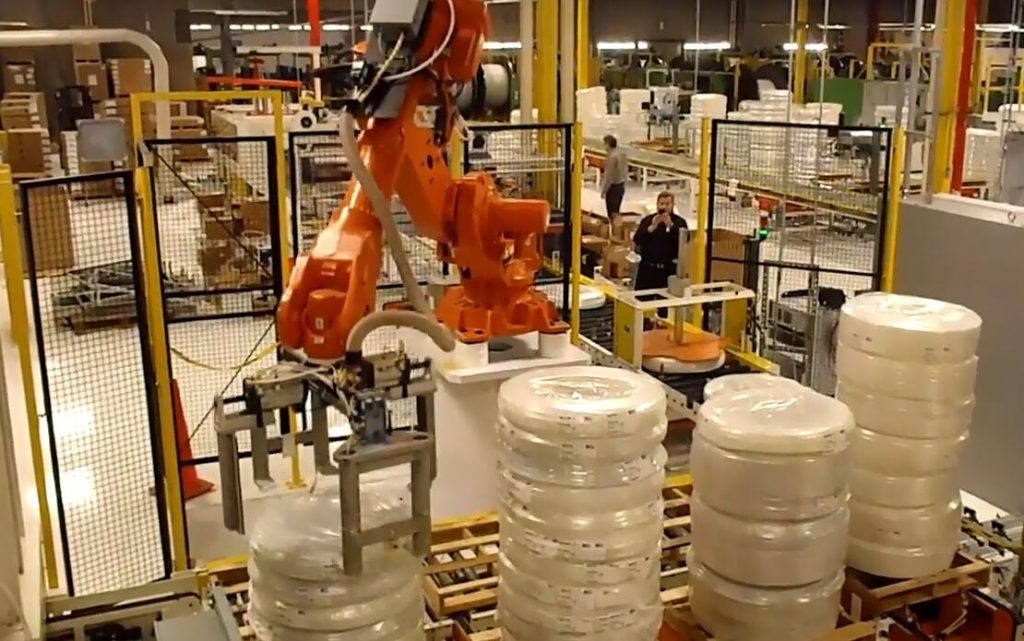
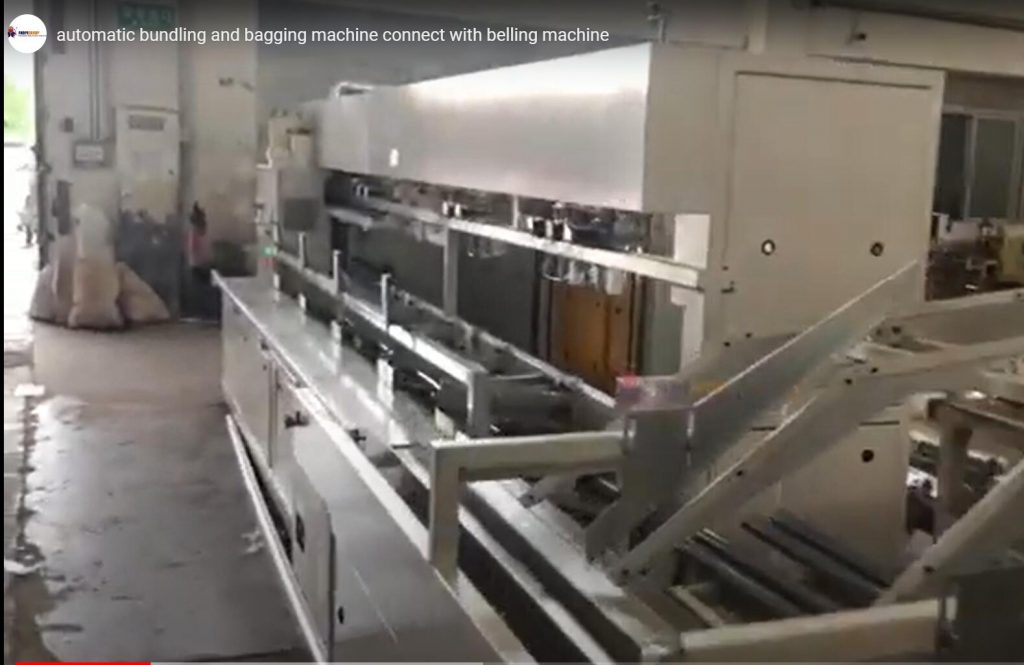
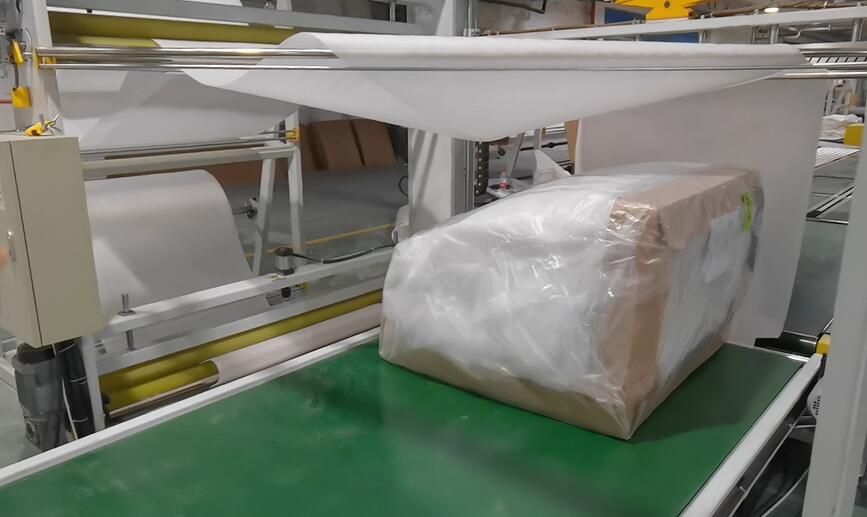
The binding head sits inside a white enclosed cabinet with a control panel and status lamp on the front. Cartons and film-wrapped stacks arrive over a roller infeed onto a green belt conveyor, pass through the black tape ring, and leave with two bright tape bands around them. In this layout the machine sits at the end of an automated packing area, next to robot handling.
Inhaltsverzeichnis
- Why bind boxes with tape
- How the binding cycle works
- Spezifikationen
- Tape use per box
- Kisten pro Stunde
- Tape band or plastic strap
- Auswahl-Checkliste
- Sicherheit
- Häufig gestellte Fragen zur Technik
- Nächster Schritt
- Verwandte lesen
- Quellen
Why bind boxes with tape
A tape band does two jobs at once: it keeps the flaps closed and it holds loose items or stacked sheets together. It sits flat, so it does not cut into soft cartons the way a tight strap can, and it needs no buckle or seal head. Hand taping gives a different pull on every box. A machine lays the band at the same position and tension every cycle.
How the binding cycle works
- Einspeisung: the box enters on the roller or belt conveyor.
- Positioning and hold-down: the conveyor stops the box at the first band position, and a top hold-down presses the carton or stack flat so loose items cannot shift while the ring turns.
- Binding: the ring turns and lays tape right around the box, then cuts it.
- Verzeichnis: the box moves to the second band position, and the ring binds again.
- Auslauf: the bound box leaves on the outfeed conveyor.
For 4 bands, the box indexes four times. Band positions are set to suit the box length.
Spezifikationen
Figures below are for our compact box tape wrapping model, not the enclosed cabinet shown above:
| Artikel | Wert |
|---|---|
| Kastengröße | up to 400 mm wide × 300 mm high |
| Bands per box | 2 oder 4 |
| Bindungsgeschwindigkeit | 2 Sekunden pro Runde |
| Klebeband | 24–48 mm wide, 50–200 m per roll |
| versorgung | 220 V, 50 Hz |
| Maschinengröße | 880 × 500 × 900 mm (base 470 mm, total height 1,370 mm) |
| Gewicht | 65 kg |
| Linienlänge | about 2,550 mm with telescopic infeed and outfeed conveyors |
The enclosed cabinet version, as shown here, takes larger boxes and stacks; its box range, size and weight are confirmed at quote. Compressed air demand is confirmed at quote.
Tape use per box
Tape per band ≈ box perimeter + overlap. Boxes per roll = roll length ÷ (bands × tape per band). For a 400 × 300 mm cross-section (example only):
| Einblick in das | Berechnung | Lösung |
|---|---|---|
| Perimeter | 2 × (0.4 + 0.3) m | 1.4 m |
| Tape per band | 1.4 + 0.1 overlap | 1.5 m |
| Tape per box, 2 bands | 2 × 1.5 | 3 m |
| Boxes per 200 m roll | 200 ÷ 3 | über 66 |
Roll changes are the main stop on a tape binder. Count them per shift when you plan the line.
Kisten pro Stunde
Boxes per hour = 3,600 ÷ (bands × 2 s + transfer time). With 2 bands and 4 s of transfer and indexing (example): 3,600 ÷ (4 + 4) = 450 boxes per hour. With 4 bands, binding time doubles to 8 s.
Tape band or plastic strap
| Artikel | Tape band | PP-Band |
|---|---|---|
| Closes flaps | yes, tape sticks | no, holds only |
| Marks on soft cartons | low, flat band | strap can cut in |
| Load held | light to medium boxes | schwerere Kisten |
| Branding | printed tape possible | begrenzt |
Auswahl-Checkliste
- What is the largest and smallest box size?
- How many bands per box, and where?
- How many boxes per hour?
- Which tape width and type do you use?
- Standalone, or linked to your conveyor or robot cell?
- Which power supply is available on site?
Sicherheit
The machine is designed to EN ISO 12100:2010 for risk assessment, EN 415-10 for packaging machine safety and EN 60204-1 for electrical equipment. The turning ring and the tape cutter are the main hazards, so the head is guarded and the cabinet doors are interlocked.
Häufig gestellte Fragen zur Technik
Q: How fast does it bind? A: 2 s per lap. Boxes per hour depend on bands per box and transfer time.
Q: Which tape does it use? A: 24–48 mm wide tape on 50–200 m rolls.
Q: Can it bind film-wrapped stacks as well as cartons? A: Yes, any stable bundle within the box size.
Q: How do I keep the tape from jamming? A: Keep the cutter blade clean of adhesive, and use the tape grade agreed at quote. Service intervals depend on the tape and are given in the manual.
Q: Can it run in an automatic line? A: Yes, with infeed and outfeed conveyors linked to your line.
Nächster Schritt
- Send your box sizes, bands per box and boxes per hour an info@fhopepack.com.
- Wir haben Größe the binding head, conveyors and tape.
- Wir antworten innerhalb von 24 Stunden mit einem Vorschlag und einem Kostenvoranschlag.
Verwandte lesen
- Automatische Kartonklebeband-Verpackungsmaschine (Produkt)
- Klebebandverpackungs- und Versiegelungsmaschine (Produkt)
- Automatische Banderoliermaschine
Quellen
- FHOPE product page: automatic box tape wrapping machine
- EN ISO 12100:2010; EN 415-10; EN 60204-1
- The carton tape binding line shown above
Letzte Überprüfung: 21.09.2026