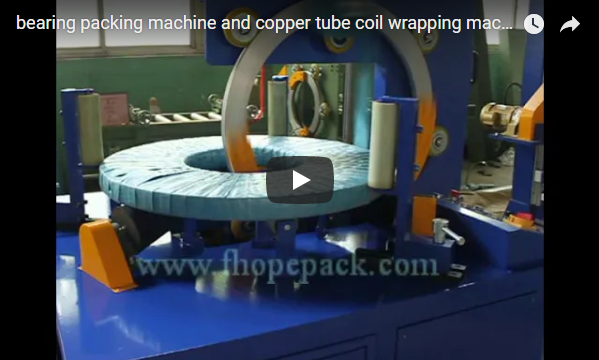
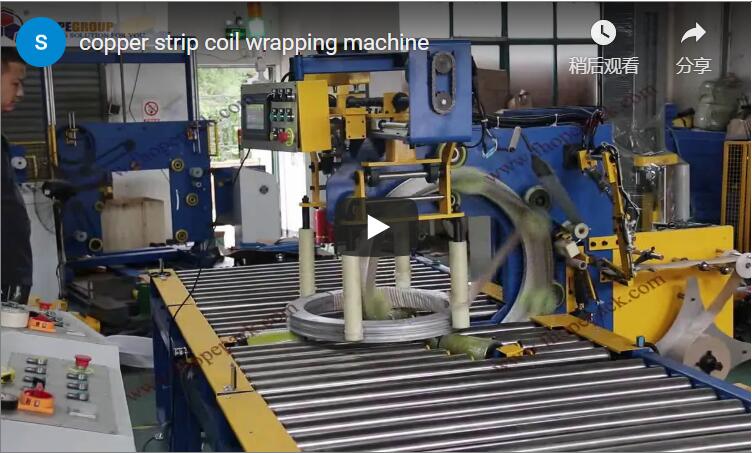
Executive summary A copper tube coil packing machine stands the coil upright on rollers and runs wrapping material through its eye on a turning ring, so the soft tube turns are covered all round. Our clip, about 43 s long, shows two operators setting a copper tube coil onto the machine, then the ring wrapping it in white material until the coil is covered. Our FPC-200 copper coil wrapper takes coils of 5 to 500 kg and wraps one in 23 to 50 s.
Inhaltsverzeichnis
- Was der Clip zeigt, in der Reihenfolge
- Zykluszeit am Clip
- How eye-through copper coil wrapping works
- FPC-200 copper coil wrapper specifications
- Taktprüfung
- Auswahlliste für einen Kupferrohr-Spulenwickler
- Kontrollen und Sicherheit
- Häufig gestellte Fragen zur Technik
- Nächster Schritt
- Verwandte lesen
- Quellen
Was der Clip zeigt, in der Reihenfolge
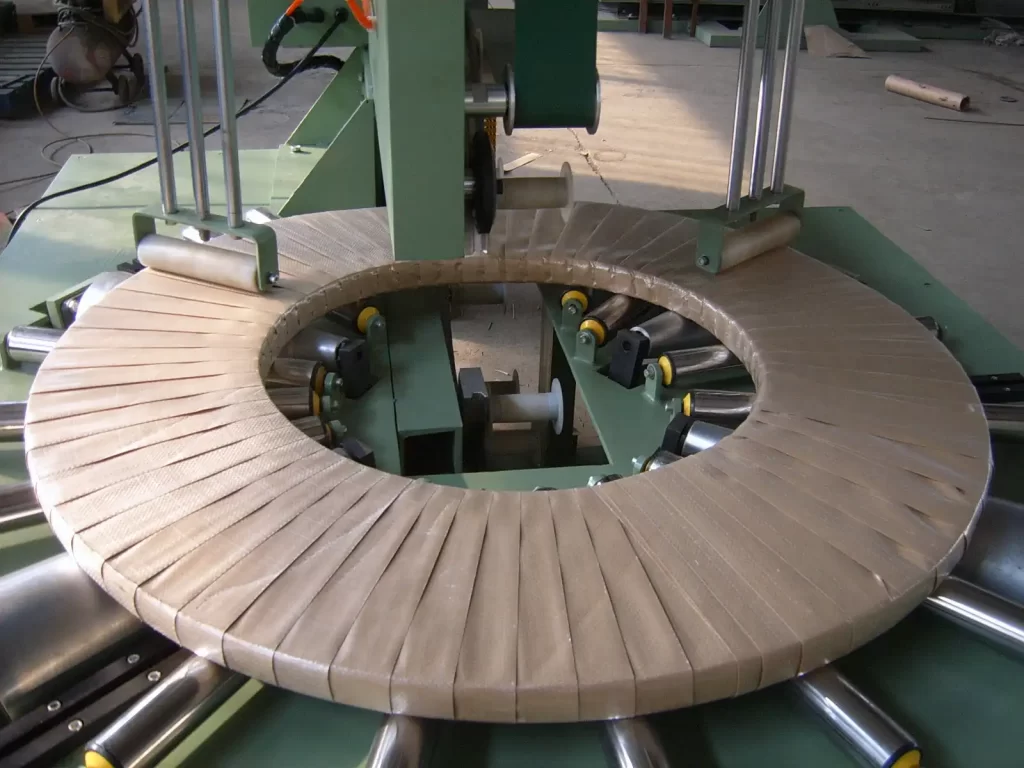
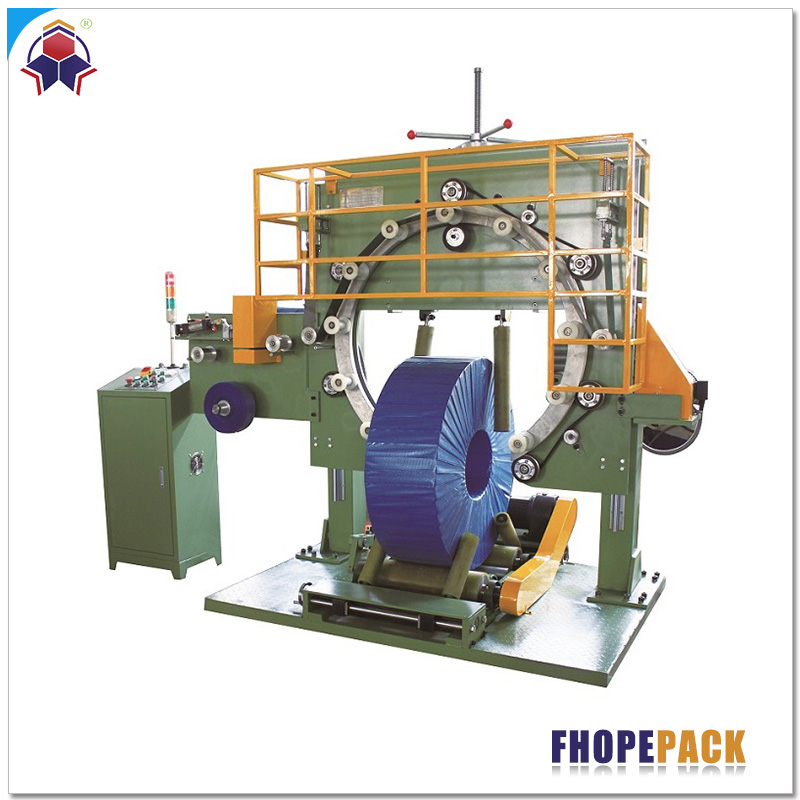
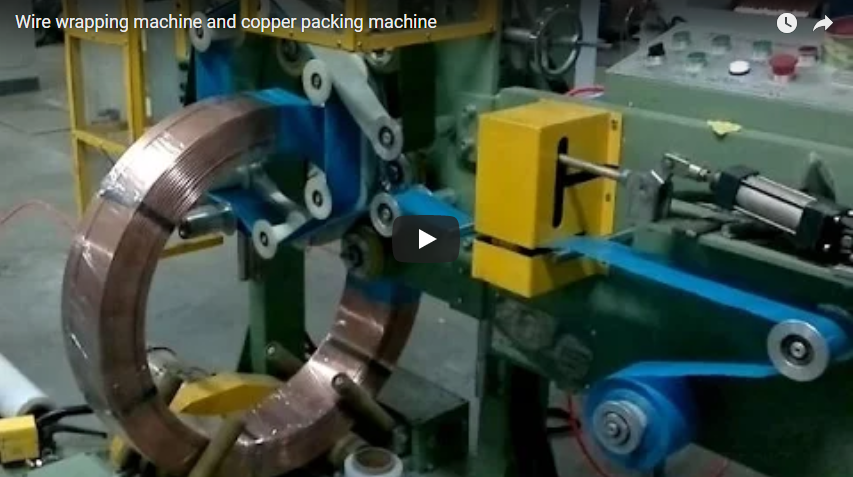
In the 43 s clip, the machine has a green frame with white guide rollers on the ring, and the coil stands upright on supporting rollers below it. More copper coils are stacked behind it in our workshop.
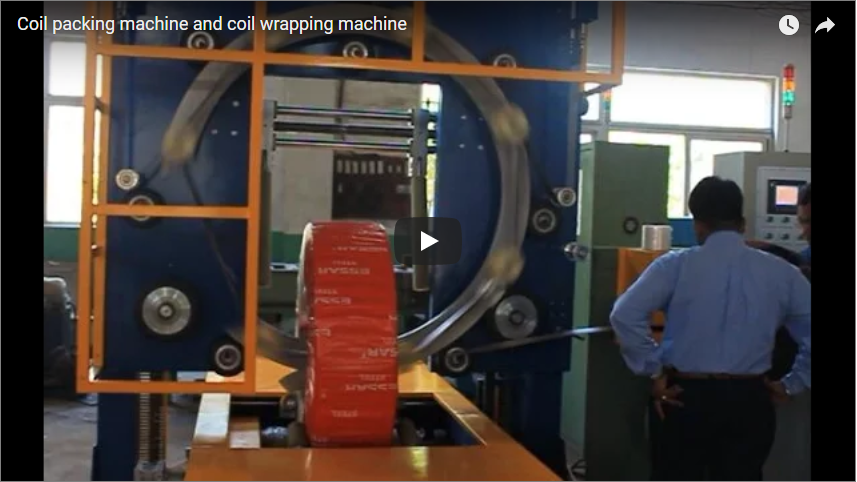
- 0 bis etwa 8 s. Two operators in white gloves set a copper tube coil upright on the rollers, with the ring passing through the coil eye. Their hands stay on the coil as the wrap starts.
- Etwa 11 bis 14 Sekunden. The ring turns, and the white material starts to cover the copper turns.
- Etwa 16 bis 35 Sekunden. Close up, the ring passes through the eye again and again while the coil turns slowly, and the cover builds round the coil.
- Etwa 38 bis 40 Sekunden. The coil is almost fully covered, with the green frame and an operator in the background.
Zykluszeit am Clip
| Treten Sie auf den Clip | Zeitfenster | Dauer |
|---|---|---|
| Spule auf den Rollen | 0 bis etwa 8 Sekunden | ca. 8 s |
| Wrap starts | etwa 11 bis 14 Sekunden | ca. 3 s |
| Wrap builds round the coil | etwa 16 bis 40 Sekunden | ca. 24 s |
The times come from frames about 2.7 s apart, and the clip ends just before the wrap is complete. Our quoted 23 to 50 s per coil covers a full wrap.
How eye-through copper coil wrapping works
The coil stands on its edge on rubber-covered rollers. The ring is a one-piece moulded part in wear-resistant polyurethane, and it carries the material roll through the coil eye and round the outside. As the ring turns at 10 to 100 r/min, the rollers turn the coil at 2 to 4 m/min, so each turn of material overlaps the last.
A tension control system holds the material tight, and the overlap is set from 20% to 90%. The machine lays one or two layers per coil and cuts the material automatically at the end. The board under the coil adjusts in height, by hand or automatically, for different coil OD.
| Teil | Was sie tut, |
|---|---|
| Polyurethane ring | Carries the material through the coil eye |
| Rubber-covered rollers | Hold and turn the coil without marking it |
| Spannungskontrolle | Keeps the material tight |
| Height-adjustable board | Sets the coil height for its OD |
| Auto Cutter | Cuts the material at the end of the wrap |
| PLC with indicator lamps | Shows the run state and lists faults |
FPC-200 copper coil wrapper specifications
| FPC-200 Kupferspulenwicklung | Normen |
|---|---|
| Coilgewicht | 5 bis 500 kg |
| Spulenbreite | 10 zu 200 mm |
| Spule OD | 600 zu 1200 mm |
| Spule ID | 300 zu 800 mm |
| OD minus ID | unter 800 mm |
| Walzengeschwindigkeit | 2 bis 4 m/min |
| Ringgeschwindigkeit | 10 bis 100 U/min |
| Wickelzeit | 23 bis 50 Sekunden pro Spule |
| Überlappung | 20% bis 90% |
| Verpackungsmaterial | Woven belt, paper or stretch film |
| Tuning | 380 V, 50 oder 60 Hz, Drehstrom |
Taktprüfung
For an illustrative copper tube line that delivers one coil every 120 s, the takt is 120 s per coil. A wrap of 23 to 50 s leaves 70 to 97 s to set the coil on and take it off.
That suits two operators at the wrapper, as on the clip. At a faster rate, we add conveyors so the coil is loaded without hands at the ring.
Auswahlliste für einen Kupferrohr-Spulenwickler
- Coil OD, ID and width, against 600 to 1200 mm, 300 to 800 mm and 10 to 200 mm.
- Coil weight, against 5 to 500 kg.
- Wrap material: woven belt, paper or stretch film.
- One or two layers, and the overlap.
- Spulen pro Stunde, gegenüber 23 bis 50 Sekunden pro Wicklung.
Kontrollen und Sicherheit
On the clip, both operators keep their hands on the coil beside the ring as the wrap starts. Hands at the coil eye while the ring turns are the move to design out. We let the rollers and the board hold the coil, so the operators step back before the ring starts.
Stop, isolate and lock out the wrapper before anyone threads material, frees a coil or reaches into the ring. Red, green and yellow lamps show the machine state, and faults are listed on the panel screen.
Die anzuwendenden Normen hängen vom Zielmarkt ab. Für CE-Märkte legt ISO 12100 die Risikobewertungsmethode fest, und EN 415-10 regelt die allgemeinen Anforderungen an Verpackungsmaschinen, einschließlich der Schutzvorrichtungen und der Not-Aus-Mechanismen.
Häufig gestellte Fragen zur Technik
Q: What copper coils fit the FPC-200? A: Coils of 5 to 500 kg, 600 to 1200 mm OD, 300 to 800 mm ID and 10 to 200 mm wide.
F: Wie lange dauert eine Wicklung? A: 23 bis 50 Sekunden pro Windung, abhängig von der Ringgeschwindigkeit und der Überlappung.
Q: Will the rollers mark the copper? A: All rollers are covered in wear-resistant rubber, and the ring is polyurethane, to protect the tube surface.
Nächster Schritt
We size a copper tube coil packing machine in three steps:
- Reichen Sie Ihre Layoutzeichnung ein. mit den Spulengrößen, Gewichten und der Leitungsleistung, bis info@fhopepack.com.
- Sie erhalten innerhalb von 48 Stunden ein Angebot., with the wrapper model, the material plan and the cycle check.
- Buchen Sie eine Standortbesichtigung so we confirm the coil handling, the loading method and the guarded ring area.
Verwandte lesen
Quellen
- Maschinenspezifikationen: FPC-200 copper coil wrapper product page
- Zeitangaben im Clip: Die Einzelbildzeiten stammen aus unserem Clip und betragen etwa 2.7 Sekunden zwischen den Einzelbildern.
- Maschine im Einsatz: unser Video auf YouTube
- Geltungsbereich der Normen: ISO 12100:2010, EN 415-10: 2014
Letzte Überprüfung: 21.09.2026