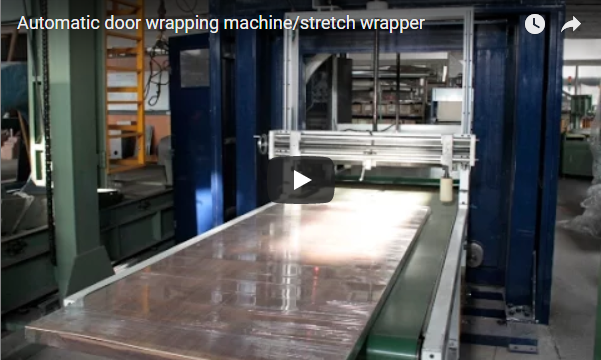
Shrnutí: Packaging finished door panels, engineered architectural slabs, and flat-pack furniture components requires decoupling surface cushioning from perimeter tension retention. Combining an automated bubble-film covering station with a high-speed orbital stretch wrapper creates a dual-layer defense: internal shock and scratch isolation coupled with weather-resistant, rigid transport containment. However, line throughput is dictated by kinematic synchronization rather than peak ring rotational velocity. This specification guide establishes the engineering protocols required to size equipment envelopes, balance film overlapping dynamics, eliminate face marking, and draft an enforceable Technical Request for Quotation (RFQ).
Decide What the Completed Package Must Protect
Specifying a packaging line begins with the structural and aesthetic vulnerability of the door panel at the point of infeed: surface gloss rating, delicate milled edge profiles, factory-fitted hinges, lock-cases, and pre-hung frame components. Engineers must map every surface that contacts conveyor rollers, alignment guides, protective cushioning, and high-tension outer film. Unpacking requirements at the job site or regional distribution center must mirror the dispatch acceptance standard: an over-tensioned pack that crushes raised moldings or causes bubble mark transfer during summer transit fails quality audits.
Define the intended handling and freight routing before establishing machine parameters:
- Broad Face Coverage: Determine whether the cushioning layer must encapsulate both the top and bottom faces, or if a single draped top/bottom sandwich is sufficient.
- Edge and Corner Enclosure: Milled edges, tongue-and-groove joints, and corner radiuses require continuous barrier protection to prevent impact splits during forklift cross-docking.
- Surface Rejection Thresholds: Clarify allowable tolerances for pressure marks, loose film tails, unsealed seams, or exposed substrate.
Keep cushioning protection and outer-wrap structural retention as separate acceptance criteria. A door panel may emerge tightly bound in orbital film while missing critical bubble cushioning along its leading edge. Conversely, a completely cushioned panel lacking calibrated stretch containment will shift during deceleration, rupturing the outer skin. Require your machinery supplier to deliver physical, wrapped sample packs for transit simulation before signing off on line configurations.
[Infeed Conveyor] ──> [Bubble Film Covering Unit] ──> [Orbital Stretch Ring] ──> [Outfeed Sorting]
                             │                                  │
                   (Shock/Scratch Layer)             (Structural Outer Shell)
Specify the Covering Station Separately from the Orbital Wrapper
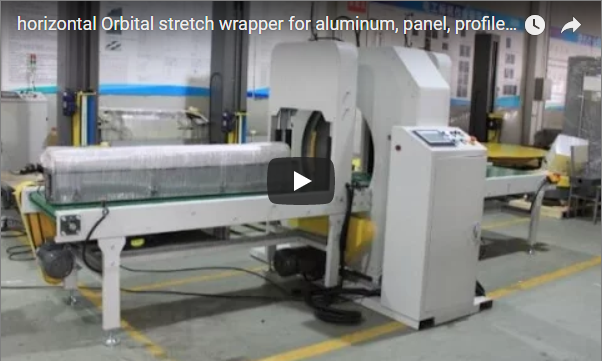
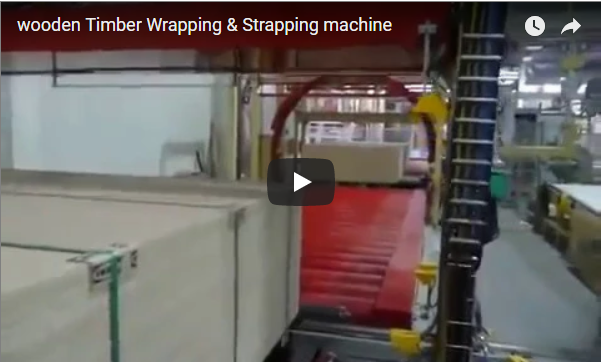
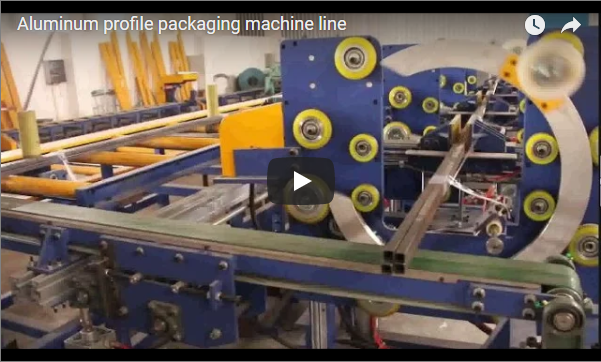
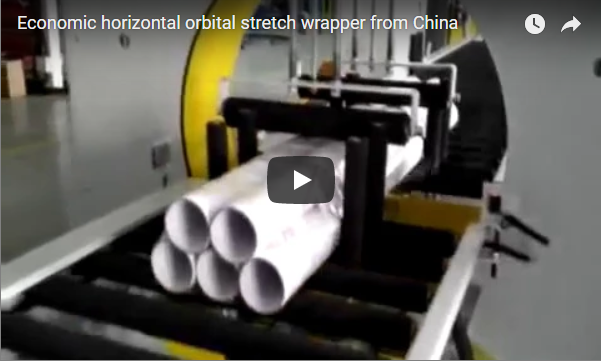
The automated packaging line comprises two functionally discrete machines integrated across a synchronized PLC bus: an upstream bubble-film covering/welding station and a continuous-pass horizontal orbital wrapper. While upstream systems utilize optical sensor arrays, pneumatic hold-downs, roll dispensers, and cross-axis heat-sealing cutters to enclose flat slabs, the downstream orbital unit applies high-tension rotary film.
Quotation documents must delineate the material flow and mechanical handoff between both stations:
- Material Path & Enclosure Mode: Confirm whether bubble film is dispensed from overhead dual rolls to create a clamshell envelopment, or if a top-and-bottom curtain configuration is welded along the sides. Ensure smooth PE film surfaces face inward toward finished veneer, keeping protruding bubbles outward to avoid localized pressure dimpling.
- Sealing & Cut-Off Kinematics: Identify which transverse and longitudinal seams are heat-sealed, which are ultrasonic-cut, and how the sealing jaw travel coordinates with continuous or index-step panel feeding.
- Orbital Wrap Start/Stop Sequence: Define how the stretch film carriage catches the leading edge of the bubble-covered panel, how clamping mechanisms secure the tail, and where the mechanical or pneumatic wipe-down roller finalizes the cut tail.
- Pitch and Panel Separation: Quantify the inter-panel pitch gap required by the infeed photo-eyes to reset the sealing bar without colliding with trailing products.
A supplier proposal referencing a “dual dispenser” without detailed mechanical drawings fails to clarify roll loading positions, jaw clearances, or orbital carriage clearances. Review the integration layout to guarantee complete mechanical clarity.
Define the Panel Envelope in Its Conveyor Orientation
Machine frame sizing depends on the maximum diagonal profile of the product pass-through. Provide a comprehensive product matrix tabulating length along the conveyor (L), cross-conveyor width (W), vertical thickness (H), and total unit weight. Always account for exterior hinges, brackets, packaging corner guards, and pallets wrapped concurrently.
       ┌─────────────────────────────┐  ▲
       │                             │  │ Height (H)
       └─────────────────────────────┘  ▼
       ◄───────── Width (W) ─────────►

  Dynamic Ring Clearance Formula:
  D_ring ≥ √(W² + H²) + 2 × C_clearance
  (Recommended Safety Margin: C_clearance ≥ 150 mm)
The usable clearance window must be verified across oba the sealing jaw gantry and the orbital rotating ring:
- Ring Sizing Envelope: The minimum internal ring diameter (
D_ring) must accommodate the panel diagonal with adequate clearance for film carriage clearance, calculated as:D_ring ≥ √(W² + H²) + 2 × C_clearancekdeC_clearancemust be at least 150 mm to account for high-speed orbital carriage projection and centripetal deflection. - Conveyor Infeed & Transfer Windows: Unsupported overhang causes thin hollow-core or multi-layer doors to bow during station transfers. Specify maximum transfer roller gaps (typically ≤ 80 mm) and implement powered side-guide rollers to maintain true centerline tracking.
- Surface Contact Integrity: Specify polyurethane, soft rubber, or nylon sleeve roller coatings throughout the transport path to eliminate scuffing on delicate high-gloss or pre-painted finishes.
Set the Wrap Pattern Before Comparing Speeds
Quoting an orbital wrapper purely on maximum ring RPM is a common engineering mistake. Line output and package integrity are governed by the overlap ratio of the stretch film, which couples ring rotational speed with linear conveyor velocity.
Film Overlap Formula:
Overlap % = [1 - (V_conveyor / (ω_ring × W_film))] × 100%

Where:
- V_conveyor = Linear travel speed (m/min)
- ω_ring     = Ring rotational speed (RPM)
- W_film = Effective stretched film width at application (m)| Parametr Metrika | Standardní ochrana | Heavy-Duty Export Pack | High-Gloss Sensitive |
|---|---|---|---|
| Overlap Ratio (%) | 30% - 50% | ≥ 65% | 50% (Low-Tension Wrap) |
Conveyor Speed (V_conveyor) |
8 – 12 m/min | 4 – 8 m/min | 6 – 10 m/min |
Ring Rotation (ω_ring) |
40 - 60 RPM | 60 - 80 RPM | 35 - 50 RPM |
| Bubble Film Layer | Single Draped (35–50 GSM) | Full Envelope (70–100 GSM) | Anti-Static Laminated Face |
| Reinforced End Bands | 2 – 3 Rotations | 4 – 6 Rotations | 2 – 3 Rotations |
To evaluate proposals accurately, specify wrap patterns across the leading edge, central body, and trailing end. Ring acceleration ramps, end-reinforcement orbital revolutions, and cutoff sequencing add cycle time. Require vendors to calculate production speed based on total completed cycles per hour rather than steady-state linear conveyor velocity.
Compare Film Use per Accepted Pack
Evaluate cushioning materials and outer wrap on an operational consumption cost-per-pack basis. Specify bubble-film material thickness (GSM or micron rating), diameter of bubble cells (typically 10 mm standard vs. 25 mm heavy-duty), roll outer diameter, and core dimensions. For the stretch-wrap stage, require the vendor to specify cast or blown LLDPE film chemistry compatible with their carriage.
- Pre-Stretch Ratio Verification: If powered pre-stretch carriages are quoted (e.g., 150% to 250%), demand the exact operational parameters used to validate those values. Thin door panels warp or buckle inward if high post-stretch contraction forces (film elastic memory recovery) exceed panel core rigidity.
- Net Consumption Metrics: Require prospective vendors to quantify packaging consumption:
- Total bubble-film surface area applied per door panel (including trim scrap).
- Net weight of stretch film consumed per unit.
- Film drop-off and changeover frequency based on continuous industrial roll lengths.
Compare these parameters under identical conditions: product dimensions, overlapping targets, and containment force must remain constant. Lower film consumption achieved by loosening wrap tension is not an optimization if it results in shifting freight and transport damage.
Use a Short Technical Brief to Make the RFQ Actionable
Transform purchasing inquiries from generic RFQs into an engineering-controlled package by organizing tender documentation across five foundational exhibits:
- Product Matrix & Physical Envelope: Dimensional boundaries (min/max
L × W × H), weight distributions, structural stiffness, surface coating chemistry, and component protrusions. - Package Layer Architecture: Exact bubble encapsulation criteria (partial drape vs. 6-sided total barrier), weld integrity, minimum outer stretch-film overlap percentage, and end-seal cutoff tolerances.
- Line Integration & Facility Layout: Upstream finishing exit heights, downstream palletizing handoffs, available plant floor footprints, structural support points, and field bus integration protocols (e.g., EtherNet/IP, Profinet).
- Throughput & Consumable Schedule: Required continuous unit-per-hour (UPH) targets, planned reel changeover frequencies, specified core sizes, and allowable material scrap rates.
- Vendor Scope & Compliance Matrix: Battery limits, utility requirements (pneumatic CFM at minimum 0.6 MPa, power kW), safety systems, factory acceptance test (FAT) requirements, and operational maintenance documentation.
       [ Exhibit 1: Dimensions ] ──┐
       [ Exhibit 2: Package Spec ] ┼──> [ Actionable Technical RFQ ] ──> Fixed Scope & Cost
       [ Exhibit 3: Plant Layout ] ┘
Review Access, Isolation, and Maintenance with the Actual Line Layout
Packaging lines integrate high-speed mechanical rotation, pinch-point conveyor drives, and heated cutting bars. Equipment safety reviews must encompass the complete functional perimeter rather than isolated safety relays.
- Hodnocení rizik (ISO 12100): Verify that machinery risk assessments comply with ISO 12100 standards, integrating functional perimeter safety fencing, Category 4 / PLe optical light curtains at open infeed/outfeed portals, and interlocked access doors to stop both ring rotation and conveyor movement upon entry.
- Safe Isolation & Stored Energy Control: Equipment isolation procedures must follow established machinery maintenance principles (such as OSHA 1910.147 and UK HSE guidelines). The design must provide zero-energy state verification, mechanical locks for heavy overhead counterweights, rapid depressurization for pneumatic cylinders, and insulated guards around hot-wire or thermal-blade cutting elements.
- Ergonomics of Material Replenishment: Heavy film rolls (bubble film jumbo rolls exceeding 30–50 kg; stretch film rolls of 15–20 kg) require ergonomic loading. Verify that carriage positions allow ground-level roll loading without requiring maintenance personnel to reach inside the rotating ring perimeter.
Agree a Sample-Pack and Line-Trial Record
Prior to final commercial sign-off and equipment delivery, mandate a comprehensive Factory Acceptance Test (FAT) protocol utilizing the customer’s actual door panels and target consumables. Record and verify the following operational results:
- Panel Integrity & Surface Inspection: Confirm zero scratch transfer, friction abrasion, or bubble pressure-ring dimpling across the highest gloss finish under intense inspection lighting.
- Enclosure Consistency: Verify continuous edge-to-edge bubble coverage, end-seal weld strength, minimum 50% orbital film overlap, and completely secured, heat-tacked or wiped film tails.
- Real-World Cycle Metrics: Validate overall cycle times, panel spacing intervals, sensor debounce timing, and real-time power and air consumption under continuous multi-pack trial runs.
- Recovery & Fault Handling: Document emergency stop recovery times, broken film detection performance, roll changeout ease, and clear jam recovery sequences without panel surface damage.
Engineering Collaboration & Specification Review
To review line configurations, transfer clearances, and envelope calculations for custom door panels and architectural furniture components, submit your dimensional matrix, package definitions, and line layouts to the FHOPE engineering team at info@fhopepack.com. Our technical specialists provide application-specific kinematics simulations, factory trial validations, and complete integration drawings.