ملخص تنفيذي
Automatic coiling and strapping systems form a critical post-extrusion link in modern plastic processing plants. When handling flexible polyurethane (PU) tubing and polyethylene (PE) conduits, packaging automation must balance rapid production throughput with product geometry protection: improper coiling tension causes irreversible cross-section ovalization, while unregulated strapping force leads to wall crimping and packaging failure. This guide examines the electromechanical architecture, tension control kinematics, radial strapping dynamics, and sizing criteria for industrial tube coiling and strapping lines.
1. How Industrial Tube Coiler and Strapping Systems Operate
A tube coiling and strapping line transforms continuous extruded profiles into compact, stable, ready-to-ship radial coils, synchronizing upstream linear extrusion with downstream batch packaging.
[Continuous Extrusion Line]
          │ (V_line: 10–80 m/min)
          ▼
[Vertical Dancer Accumulator] ── Dynamic Tension & Loop Buffering
          │
[Dual-Spindle Turret Coiler] ── Auto Traverse Pitch & Diameter Sizing
          │ (Precision Servo Shear: Flying Cut)
          ▼
[Through-the-Eye Radial Strapping Module] ── Core-Penetrating 3/4-Point Tie
          │ (Torque-Regulated Weld: 150–600 N)
          ▼
[Powered Ejection / Downending Conveyor]
In-feed and Dynamic Tension Accumulation
Tubing feeds from cooling troughs, haul-off caterpullers, or bulk payoff stands. Because coiling reels accelerate, decelerate, and index, an integrated vertical dancer accumulator buffers the continuous feed; encoders measure loop displacement and provide ±10 V / 4–20 mA analog feedback for real-time spindle torque modulation.
Precision Coiling and Traverse Pitch Mechanism
Tubing enters an automated dual-spindle or collapsing-mandrel coiling unit:
- Rotary Mandrel: Adjusts coil inner diameter (ID) dynamically, typically 150 mm to 500 mm.
- Servo Traversing Guide: Synchronizes traverse speed with reel rotational speed and tube OD so that
V_traverse = Pitch_factor × OD × (ω_reel / 2π)، معPitch_factorcalibrated between 1.02 and 1.08 to prevent cross-winding overlaps. - Constant Surface Velocity: The drive reduces spindle speed as coil build-up diameter expands, keeping web tension consistent:
Tension (N) = Motor Torque / (D_coil / 2).
Flying Cut Station
When the preset length is reached (verified via quadrature encoders), pneumatic clamps immobilize the tube tail while a servo-driven rotary blade executes an instantaneous square cut; the trailing end is tucked into the inner coil periphery before transfer.
Through-the-Eye Radial Strapping
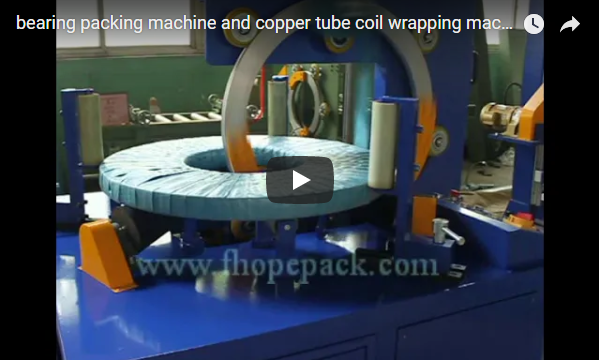
The wound coil transfers to the strapping station via transfer arms or indexing tables. Unlike carton strappers that wrap parallel perimeters, a coil strapper uses a through-the-eye radial mechanism: a split strap track traverses the central core eye; the head indexes the coil at 90° or 120° increments, applying 2, 3, or 4 radial bands; then tensioning rollers exert calibrated pull followed by friction-weld or ultrasonic sealing.
2. Product Specifications Matrix
The machine accommodates pneumatic PU tubing (4×2.5 mm up to 16×12 mm) and microduct/corrugated/smooth PE conduit (16 mm up to 110 mm OD):
| المعايير الهندسية | التصنيف الصناعي / النطاق | الملاحظات الفنية |
|---|---|---|
| Tube Outer Diameter (OD) | 6 mm to 110 mm (up to 160 mm) | Configurable guide roller sets; smooth polyurethane surfaces |
| القطر الداخلي للملف (ID) | 150 mm to 600 mm (Adjustable) | Pneumatically collapsing segments for easy core extraction |
| القطر الخارجي للملف (OD) | 300 مم إلى 1,200 مم | Regulated by coiling frame envelope and optical limit arrays |
| Coil Width / Traverse Span | 80 مم إلى 400 مم | High-precision ball screw driven by AC servo motor |
| أقصى وزن للملف | Up to 150 kg (Standard) / 500 kg (Heavy Duty) | Cantilevered spindle with outboard pneumatic bearings |
| Extrusion Line Speed | 5 م / دقيقة إلى 80 م / دقيقة | Dancer-position closed-loop PID synchronization |
| مادة الربط | البولي بروبيلين (PP) / البوليستر (PET) | 9–15 mm strap width; 0.6–0.9 mm gauge |
| نوع الربط | Radial (Through-the-Eye) | 2, 3, or 4 bands via rotary table indexing |
| وقت دورة الربط | 12 to 18 seconds per band | Track advance, tensioning, weld, and indexing |
| هندسة التحكم | سيمنز S7-1500 / ألين برادلي كومباكت لوجيكس | 10″ Color HMI; Profinet / Ethernet/IP fieldbus |
| العرض الجوي | من 0.6 إلى 0.8 ميجا باسكال (هواء جاف ومُرشَّح) | 150–300 Nl/min depending on cycle frequency |
3. Engineering Advantages of Automated Tube Coiling & Strapping
Automated post-extrusion packaging addresses distinct mechanical, quality, and economic challenges:
- Mitigation of Tube Ovalization and Kinking: Flexible polymers deform under uncontrolled bending. Automated systems enforce the material’s minimum bend radius so that
R_bend ≥ k × OD(k ≥ 8for flexible PU;k ≥ 20for rigid HDPE at 20°C), preserving circularity across inner core layers. - Labor Rationalization: A single plant technician supervises up to three extrusion lines, replacing 2–3 manual packaging workers per shift per line.
- Scrap and Off-Cut Elimination: Manual cutting produces length variations of ±1.5%; microprocessor length counters with high-speed shears achieve precision within ±0.1%, eliminating off-spec rejections.
- سلامة المشغل وبيئة العمل: Automated enclosures with Category 4 light curtains (ISO 13849-1) remove burn, repetitive-strain, and entrapment risks from manual handling of hot coils.
- OEE and SCADA Traceability: Built-in PLCs record runtime, total footage, coil count, strap consumption, and alarms, exporting to plant MES networks via OPC-UA.
4. Strapping Technology and Tension Optimization
Securing elastic and semi-rigid tubular structures requires careful band material and tension selection.
              [Strapping Material Selection Matrix]
                                │
       ┌────────────────────────┴────────────────────────┐
       ▼                                                 ▼
[PP (Polypropylene)]                             [PET (Polyester)]
- Width: 9–12 mm                                 - Width: 12–16 mm
- Tensile Break: 1,000–2,200 N                   - Tensile Break: 2,500–5,500 N
- Elastic Recovery: High                         - Creep Resistance: Outstanding
- Target: Light PU coils, small OD               - Target: Large PE coils, heavy loads
- Weld: Thermal / Friction (80–85% Joint)        - Weld: Ultrasonic / Friction (>85% Joint)
Material Physics: PP vs. PET vs. Steel
- البولي بروبيلين (ب): The standard choice for pneumatic PU tubes, medical-grade tubing, and lightweight PE microducts; its high elongation recovery adapts to minor coil expansion during temperature shifts.
- بوليستر (PET): Preferred for heavy HDPE sub-ducts and corrugated pipes; superior tensile strength and low creep keep coils tight during long ocean shipping.
- Steel Strapping Constraints: Steel is rarely used in direct contact with flexible plastic tubing because sharp edges cut into soft PU jackets and crush PE conduits. If high-tensile steel restraint is required, applicators must first position plastic corner buffers or heavy chipboard saddle protectors.
Tension Regulation and Surface Safeguards
- الشد الزائد: Exceeds the compression limit of the tube profile, causing permanent local ovalization, wall thinning, or lumen collapse.
- Under-Tensioning: Lets coil loops slip axially, causing telescopic unraveling during palletizing or transit.
Modern packaging heads use variable-frequency drives or servo-actuated tension grippers. Tension is set digitally between 150 نيوتن و 600 نيوتن on the HMI based on wall thickness and the ratio OD / S_wall.
5. Extrusion Line and Downstream Packaging Integration
Continuous production flow requires structured line layout:
+-----------------------------------------------------------------------------------------+
|                                    TYPICAL FACTORY FOOTPRINT                            |
|                                                                                         |
| [Extruder & Cooling] ──> [Haul-off] ──> [Dancer Tower] ──> [Turret Coiler]             |
|                                                                   │ (Transfer Arm)      |
|                                                                   ▼                     |
| [Palletizer / Storage] <── [Ejection Conveyor] <── [Radial Strapping Station]           |
+-----------------------------------------------------------------------------------------+- Direct In-Line Extrusion Synchronization: Extrusion cannot stop for coil discharge. Dual cantilevered reels on a motorized 180° indexing turret cut the tube when Reel A reaches its target length, and the traverse guide diverts the feed to Reel B without deceleration.
- Transfer to Orbital Stretch Wrapper (Optional): In dusty or export environments, coils pass into an inline horizontal orbital wrapper where PE stretch or VCI barrier film provides dust-proof, moisture-sealed packaging.
- Automated Coil Downending and Palletizing: Strapped coils roll down a pneumatic discharge chute or are picked by a gantry with expanding mandrel grippers; a downender re-orients coils from eye-horizontal to eye-to-sky for pallet stacking.
6. Engineering Selection & Sizing Guide
Configure equipment sizing by assessing these variables:
Step 1: Quantify Tube Parameters (OD, ID, Wall Thickness, Material: PU / LDPE / HDPE)
        │
Step 2: Calculate Coil Dimensions (Target ID, Maximum OD, Stack Width, Weight)
        │
Step 3: Define Dynamic Throughput (Extrusion Line Speed m/min -> Cycles/Hour)
        │
Step 4: Establish Packaging Level (Radial Strapping Only vs. Strapping + Stretch Wrap)
        │
Step 5: Verify Utility Availability (400V/480V 3-Phase, 0.6–0.8 MPa Compressed Air)
Operational Checklist for Sizing
- Material Elastic Modulus: Soft ester/ether-based PU behaves elastically; high-density PE shows strong spring-back, requiring stiffer mandrel construction and higher strap holding strength.
- Minimum Core ID Constraint: Confirm the tube diameter can form the target inner diameter without exceeding outer fiber elongation limits (typically under 5% total strain).
- Line Speed vs. Strapping Index Cycle: Total cycle time for turret indexing, radial strapping, and discharge must be shorter than the time to wind a full coil on the secondary spindle.
7. Technical Consultation and Implementation Steps
To transition from manual packaging to a fully automated post-extrusion cell:
- Define Detailed Processing Parameters: Document tube OD, wall thickness range, material grades (PU, LDPE, HDPE, PA), coil core IDs, target coil lengths, and maximum extrusion speeds.
- Contact System Engineering: Email specifications and plant layout dimensions to info@fhopepack.com.
- Review Functional Specification Document (FSD): Receive a detailed proposal within 48 hours, including line CAD layouts, throughput and cycle-time balancing, safety schematics, and utility requirements.
- Approve Design and Factory Acceptance Testing (FAT): Finalize mechanical layouts, software sequencing, and FAT criteria prior to manufacturing release and site commissioning.