ملخص تنفيذي For export wire coils, our packaging line takes each coil off the collecting rack, straps it, wraps it at separate paper and film stations, then weighs and labels it. Lines handle coils from 30 kg to over 6,500 kg, with 500–1,500 mm OD, at 20–40 coils an hour. Strapping takes up to 35 s a cycle and wrapping 20–120 s a coil. A worked example shows why two wrapping stations in a row keep a paper-and-film pack at full line rate.
جدول المحتويات
- What an export wire coil pack needs
- From collecting rack to labelled coil
- Wire coil packaging line data
- Worked example: the slowest station sets the rate
- Weighing and labelling for export papers
- ظروف الموقع
- قائمة التحقق من الاختيار: ما الذي يجب إرساله إلينا
- السلامة والمعيار الأوروبي EN 415-10
- أسئلة وأجوبة هندسية
- الخطوة التالية
- القراءة ذات الصلة
- مصادر
What an export wire coil pack needs
A wire coil going by sea needs three things. Straps keep the rings tight while the coil is lifted and shaken. A moisture barrier keeps rust and water spots off through weeks of humid air. And a correct weight and label let the coil clear the port and reach the right customer.
Doing that by hand means a crane, a strapping tool, two people wrapping and a separate scale. On a line, each step has its own station and the coil moves between them on conveyors.
From collecting rack to labelled coil
- التفريغ. The coil stands in a vertical collecting rack with upright posts. A manipulator grips it and pulls it out as the rack tilts back, then sets it on the roller conveyor.
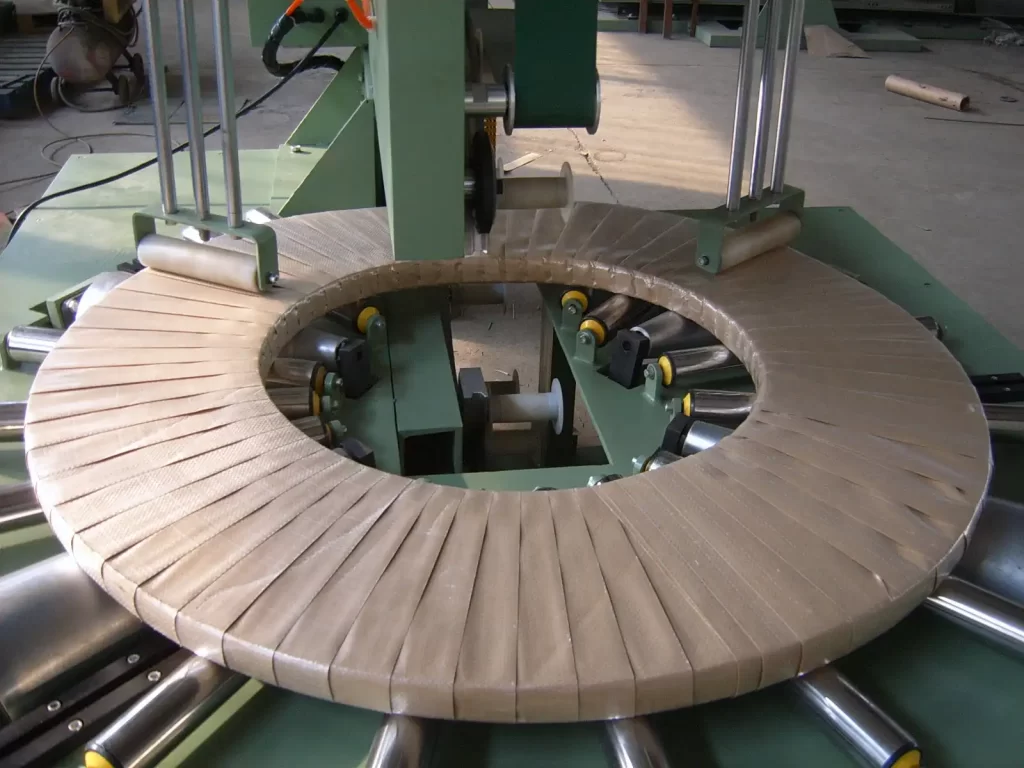
- ربط. Green PET strap comes down from an overhead dispenser. The head tensions it round the coil section and seals it, then the coil indexes to the next strap point.
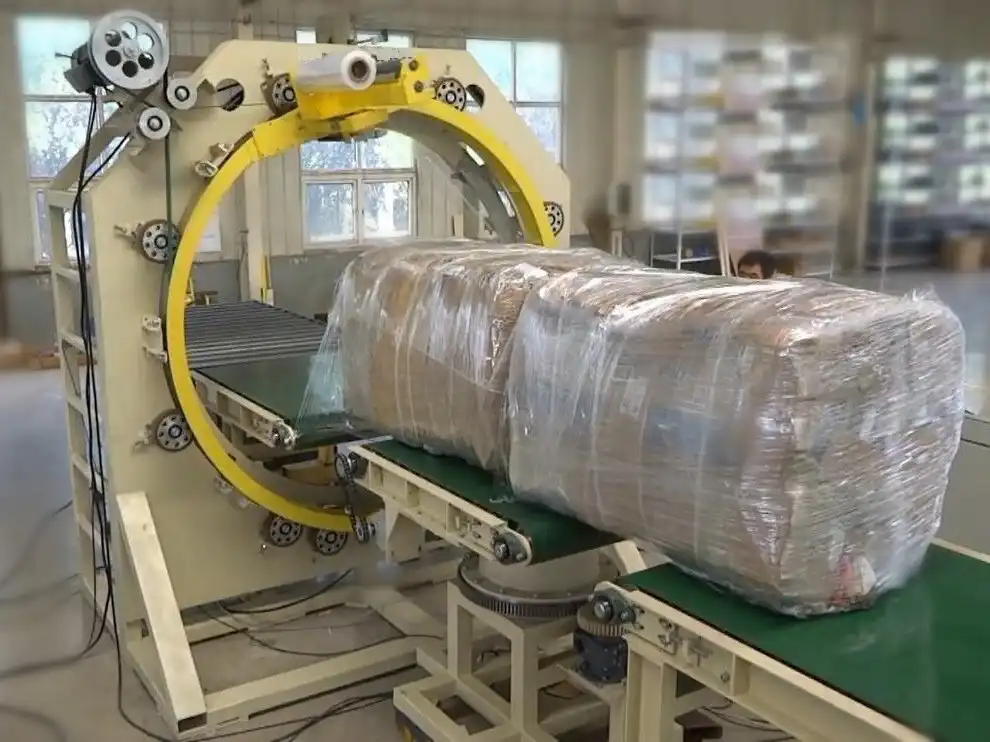
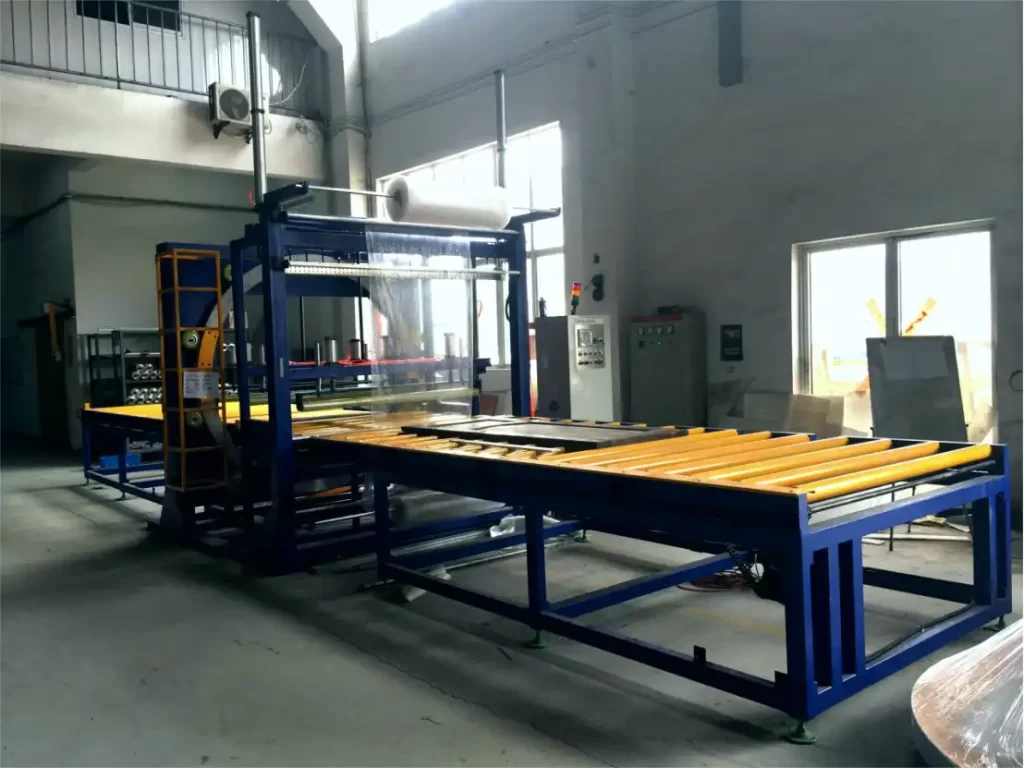
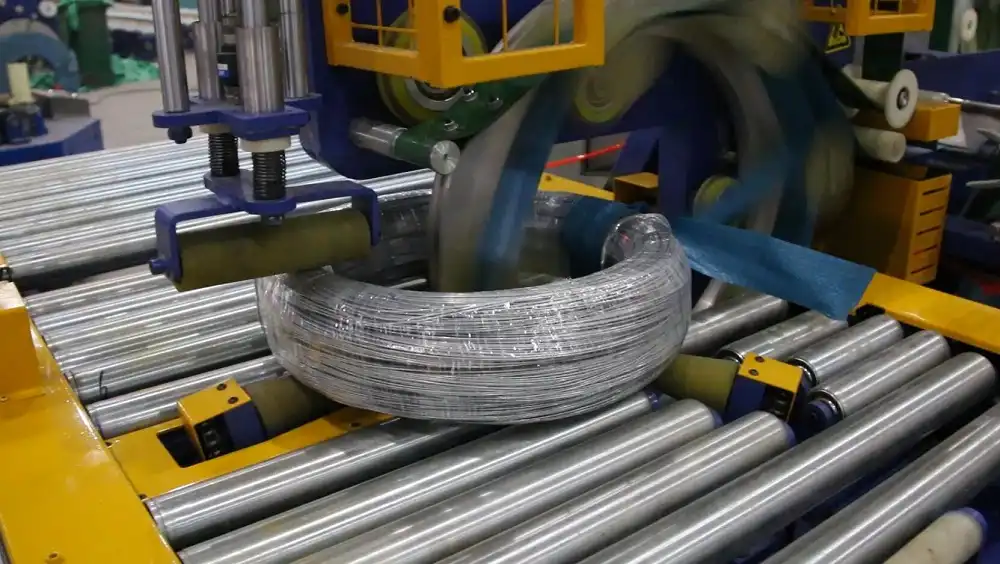
- يلف. Paper and film stations wrap the coil through the eye, each with its own ring.
- وزن. A scale weighs the coil on the conveyor, and the reading shows on a panel display.
- وضع العلامات. A print-and-apply labeller fixes the label, and the coil moves to the outfeed for stacking.
A signal tower on the control desk shows the line state, and yellow mesh guards cover the moving parts above the strapping and wrapping units.
Wire coil packaging line data
| العناصر | Wire coil packaging line |
|---|---|
| الوزن فائف | 30 kg to 6,500 kg and more, light to heavy lines |
| لفائف OD | 500 – 1,500 مم |
| لفائف معرف | 300 أو 508 أو 610 مم |
| عرض لفائف | 20 – 500 مم |
| الناتج | 20–40 coils an hour, depending on automation |
| ضخم | up to 35 s per cycle, PET or steel head |
| التغليف | 20-120 ثانية لكل لفة |
| محطات الالتفاف الخلفي | two, film and paper |
| وزن | automatic, 1/3,000 accuracy |
| وسم | اطبع وطبق |
| السيطرة | Siemens S7-1200 or 1500F PLC, 12–15 in touch screen |
| أسطح التلامس | PU-coated rollers and tilters |
Worked example: the slowest station sets the rate
A plant ships wire coils overseas and wants paper under film on every coil. It needs 36 coils an hour. On its coils, the paper wrap takes 90 s, the film wrap 60 s and strapping 35 s. These are illustrative customer figures, inside the line's 20–120 s wrapping range.
Time per coil needed. 3,600 ÷ 36 = 100 ثانية.
One wrapping station doing both. Paper then film on the same ring takes 90 + 60 = 150 s. The line can only manage 3,600 ÷ 150 = 24 coils an hour.
Two stations in a row. Each coil spends 90 s at the paper station and 60 s at the film station. Coils move through both stations at the same time, so the slowest station sets the pace. The slowest is paper at 90 s, giving 3,600 ÷ 90 = 40 coils an hour, more than the 36 needed.
ربط. Count the straps. If the 35 s cycle is per strap, two straps take 2 × 35 = 70 s, inside the 100 s budget. Three straps take 3 × 35 = 105 s, which drops the line to 3,600 ÷ 105 = 34 coils an hour and makes strapping the limit. A second strapping head or fewer straps fixes it.
Strap time depends on the head and strap. On one coiling line we quoted about 60 s for 4 straps, roughly 15 s a strap, and the strap count can be changed in the program.
The rule is: coils per hour = 3,600 ÷ (longest station time + t), where t is the transfer time between stations that we set in the layout.
Weighing and labelling for export papers
The scale weighs each coil on the line, so the weight on the label matches the coil. With 1/3,000 accuracy, a scale sized for 3,000 kg resolves to 3,000 ÷ 3,000 = 1 kg.
The labeller prints the weight and coil data, and the PLC and HMI track the pack online. Packing lists and port papers can then come from the same data.
ظروف الموقع
The equipment works from −10 °C to +45 °C. The electrical cabinets need air conditioning at 23 ± 2 °C, which matters in a hot, humid port-side plant. All contact surfaces that touch the wire, on rollers and tilters, are PU coated against scratching.
قائمة التحقق من الاختيار: ما الذي يجب إرساله إلينا
- Coil OD, ID and width, smallest and largest.
- أثقل لفة.
- عدد اللفات في الساعة.
- Strap: PET or steel, and how many per coil.
- Wrap: paper, film or both, and the order.
- Label data and the scale capacity you need.
السلامة والمعيار الأوروبي EN 415-10
We build our coil packaging lines to CE requirements, with EN 415-10 as the reference and an ISO 12100 risk assessment. The main hazards are the manipulator, the strapping head, the turning wrapping rings and the conveyors.
Mesh guards cover the moving parts above the stations. Fence the manipulator and conveyors, with interlocked gates or light curtains chosen in the risk assessment, so the line stops if someone enters. The signal tower shows when the line is in automatic.
أسئلة وأجوبة هندسية
Q: Can we start with strapping only and add wrapping later? A: Yes. The add-ons are modular, so stations can join the line later.
Q: PET or steel strap for export coils? A: Both heads are available. We choose by coil weight and how the coil is lifted at the port.
Q: Will the line mark galvanised or coated wire? A: The rollers and tilters that touch the wire are PU coated to prevent scratching.
Q: Which safety standards apply? A: EN 415-10 is our reference for CE markets, backed by a risk assessment to ISO 12100.
الخطوة التالية
- Email your coil sizes, hourly rate and packing materials إلى info@fhopepack.com.
- سنرد عليك خلال 24 ساعة بمقترح., with the stations and layout.
- نرسل رسم تخطيطي for your floor space.
القراءة ذات الصلة
- Wire coil packaging line
- آلة ضغط وربط لفائف الأسلاك
- Steel coil packaging line updates your coil package process
- آلات لف الأسلاك الملفوفة
- ضغط لفائف قضبان الأسلاك الفولاذية الأوتوماتيكية بآلة الربط
مصادر
- Specifications: FHOPE wire coil packaging line product page
- Line video: wire coil strapping and packing line on YouTube
- Station times and coils per hour: our worked example, illustrative coil figures
- المعايير: EN 415-10 (آلات التعبئة والتغليف، السلامة العامة)؛ ISO 12100:2010
آخر مراجعة: 2026-10-17