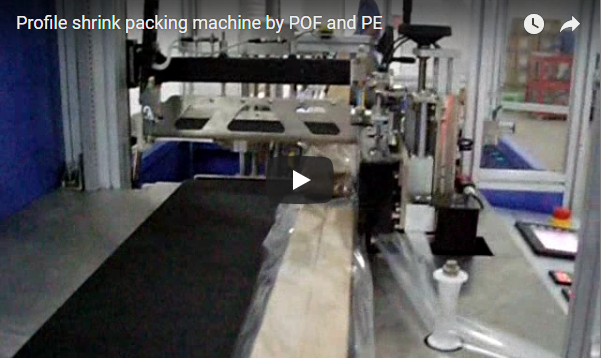
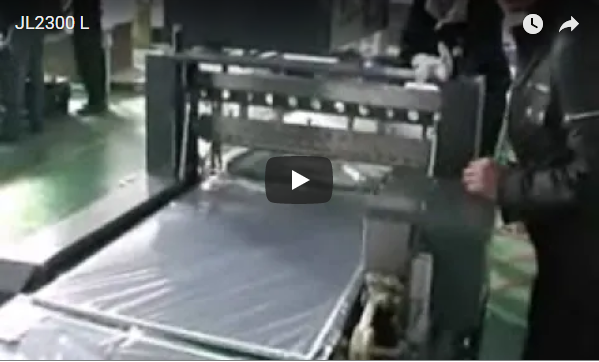
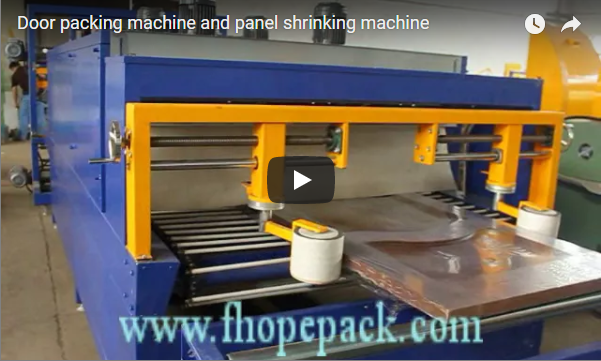
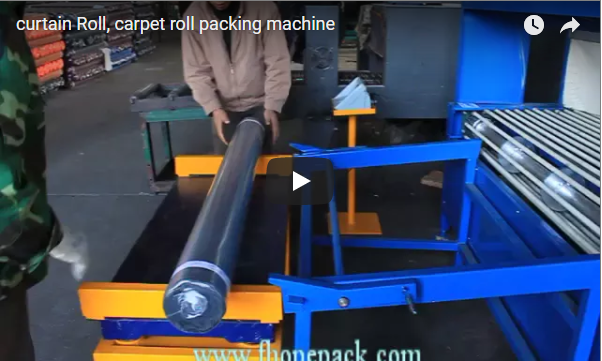
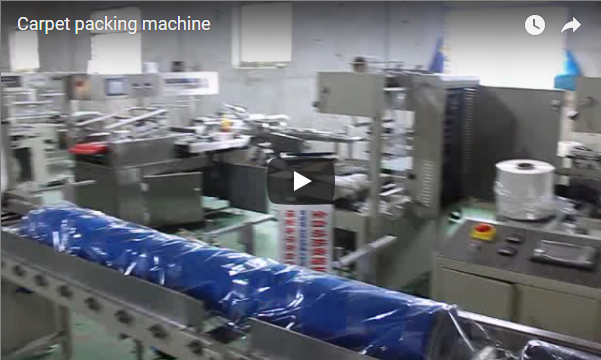
ملخص تنفيذي This video shows a carpet roll sealing and shrinking packing machine in operation: large carpet rolls are placed on roller stands, wrapped in plastic film, sealed, and passed through a heat-shrinking zone until the film tightens around each roll. The footage covers the full infeed-to-output sequence, red safety guarding, and a robotic clamping unit over the conveyor. Specs such as roll diameter limits, cycle time, film thickness, and heating temperature are not shown — request them from the manufacturer before purchasing.
Why this machine matters for carpet producers
Carpet rolls are heavy, flexible, and vulnerable. Left unwrapped, they collect dust, absorb moisture, and arrive at the customer with scuffed edges. Wrapping them by hand is slow and inconsistent — one operator wraps tightly, the next wraps loosely, and quality varies roll to roll.
A dedicated sealing and shrinking machine solves this in three moves: it wraps each roll in plastic film, seals the film, and then shrinks it with heat so the plastic pulls tight against the roll surface. The result is a compact, sealed, uniform package on every roll, ready for warehouse storage or container shipping.
The video on this page shows exactly that process running end to end. Below we describe what the footage actually shows, what it deliberately does not show, and the questions you should ask before buying equipment like this.
ما يظهر الفيديو
The footage is a continuous walkthrough of the machine line, with only background music — no narration or voiceover. Here is the sequence, tied to approximate timestamps:
- 0-9 ثانية: Fast-moving shots of a conveyor system with red safety fencing around it. A light-green material roll moves quickly along the belt; a red-and-white machine frame is visible on the right side.
- 12 ثانية: The camera settles on a clear view of a large light-green roll (with printed patterns on its surface) resting on a roller stand above silver metal rollers. The workshop floor is visible in the background.
- 15-18 ثانية: More rolls join the frame — a white roll, then a third green roll — arranged side by side on a white metal support frame. Shelving and a tool bench appear in the background.
- 21 ثانية: A view inside the machine: a black mesh conveyor belt running, with a white paper label on the right side and a red column partially blocking the view.
- 24-27 ثانية: Material is fed into the sealing and shrinking area. A long strip of semi-transparent film wrapped around product moves forward on the conveyor, with an arm/clamp structure overhead and a person in a light-colored top standing nearby.
- 30-33 ثانية: The wrapped product continues into the heat-shrinking zone. The film appears wrinkled and partially shrunk; pneumatic components and guide rails are visible on the equipment.
- 36-42 ثانية: The package emerges from initial heat shrinking with a tighter, more compact shape. The arm finishes its motion and the scene stabilizes.
- حوالي 45 ثانية: Two partially wrapped carpet rolls move right along the conveyor while the central arm/clamp unit hovers above. No operator is present — this portion is fully automatic, continuous operation.
العملية خطوة بخطوة
Putting the timeline together, the machine handles each carpet roll through four stages:
- Infeed and staging (≈12–18s): Large carpet rolls are placed on roller stands, with several rolls staged side by side for continuous processing.
- Unrolling and flattening (≈24–27s): A roll is guided out, formed into a continuous wide band, and fed toward the sealing and shrinking station.
- Film wrapping and sealing (≈30–33s): The band is covered with a layer of transparent film, creating a double-layer wrap; the overhead arm appears to assist with positioning or pressing.
- Heat shrinking (≈36–42s and beyond): Heat causes the film to contract and hug the roll surface tightly, and the finished, sealed cylindrical package exits the line.
At the 45-second mark, the line is running with no operator in frame — partially wrapped rolls move along the belt while the clamp unit works on the next piece. This is the practical payoff of the design: after loading, the machine continues on its own.
ملاحظات الملاحظة المباشرة
The following notes stay close to what is directly visible in the footage, with only grammar-level editing for readability:
- The machine frame is a white-painted metal body; safety fencing and columns are bright red painted steel; transparent protective guards cover key working areas.
- Main visible components include a multi-section conveyor system (mesh and flat belts), roller stands supporting large rolls, a sealing/heat-shrinking unit with heating and pressing elements, pneumatic actuators with guide rails, and an arm/clamp device above the shrinking zone.
- No control panel is clearly visible in any frame — no screen, button array, or indicator lights can be read. A white sticker seen inside the machine at 21s is unreadable.
- Product rolls are light green (some with printed patterns on the surface), wrapped in transparent or milky film. Estimated roll diameter is roughly 60–80 cm based on comparison with a person standing nearby; roll width appears to be around 100–120 cm. The film layer is thin, glossy, and semi-transparent.
- Roll orientation changes through the process: rolls travel horizontally at first, rest upright on roller stands, and are then formed into a flat band for wrapping before becoming a compact cylinder again after shrinking.
- The only character-level readable marking is “MEL”, appearing in red/black lettering on a white side panel in several frames. A label on the red column (frames 14–15) shows red-background graphics with white lettering, but the characters are too blurred to confirm — treat all other text as unreadable.
- No clearly readable warning signs or emergency-stop buttons are visible in most frames, though a black elongated handle on the right red column (around 45s) may be an emergency stop or door-lock switch — verify with the manufacturer.
ما لا يُظهره الفيديو
For a buying decision, the following are not observable in the footage and must be confirmed directly:
| معلومات مفقودة | لماذا يهم |
|---|---|
| Rated power, voltage, frequency | Determines electrical preparation at your plant |
| زمن الدورة لكل لفة | Sets realistic throughput expectations |
| Max roll diameter / width / weight | Confirms whether your product sizes fit |
| Film material spec (PE/PP/PET, thickness) | Affects consumable cost and sourcing |
| Shrinking temperature and airflow settings | Relevant for heat-sensitive carpet backings |
| تسمية طراز الآلة | Needed for quotes, spares, and documentation |
| CE/UL certification markings | Required for compliance in many markets |
| شروط الضمان وما بعد البيع | Long-term cost of ownership |
None of these figures appear on screen. Any numbers you find elsewhere should be verified with the manufacturer.
Safety and guarding notes
From what is visible:
- الحراسة الجسدية: Bright red steel fencing surrounds the machine, and transparent hard guards cover key working zones. This matches standard practice around moving conveyors and heat-shrinking units.
- Overhead moving parts: The arm/clamp assembly operates above the conveyor, so its travel area must remain fully guarded during operation.
- Heat zone: The shrinking area involves heated elements. In the footage, no explicit high-temperature warning signage is clearly readable — this is worth confirming during a factory inspection.
- التوقف في حالات الطوارئ: A black handle on the right red column may serve as an emergency stop or guard-door lock. Its exact function is not confirmed by the video — check with the manufacturer.
- الانترلوك: No interlock indicators are visible. Standard industrial design would include “open door = stop” logic, but this is an inference, not a direct observation.
Operators working near the heat zone should wear appropriate protective gear as a routine precaution.
أين يناسب هذا الجهاز
Based on the product handling visible in the video, typical applications include:
- Carpet and rug mills: sealing finished rolls before warehouse storage or export packing.
- Similar flexible roll goods: vinyl flooring, nonwoven fabric, and other rolled soft materials that need dust- and moisture-proof wrapping — the same handling principle applies, though suitability for specific materials should be confirmed.
- Batch operations with multiple roll sizes: the video shows several rolls of different sizes staged together, suggesting the line tolerates variation — confirm the actual size range with the manufacturer.
The key benefit shown indirectly is packaging consistency: after shrinking, every roll emerges with film pulled tight and edges sealed, which is difficult to achieve uniformly by hand.
قائمة التحقق من هوية المشتري
قبل طلب عرض سعر، استخدم هذه القائمة لتنظيم محادثتك مع المورد:
- Confirm compatible roll diameter, width, and weight ranges (including your largest and smallest SKUs).
- Ask for cycle time per roll and realistic hourly throughput.
- Specify which film material and thickness you plan to use; ask if the machine handles alternatives.
- Ask about temperature control and exhaust in the shrinking chamber, especially for heat-sensitive products.
- Confirm safety features: interlocked guards, emergency stop placement, high-temperature warnings.
- Ask about automation interfaces: conveyor height/width matching, synchronization signals with upstream equipment.
- Request warranty terms, spare parts availability, and remote support options.
الأسئلة الشائعة
What product does this machine pack? It packs cylindrical carpet rolls — flexible rolled material wrapped in plastic film, sealed, and heat-shrunk into a tight package, as shown throughout the video.
هل تعمل الآلة تلقائيًا؟ The footage at around 45 seconds shows the line running with no operator in frame, with rolls feeding and the clamp unit working continuously. The extent of automatic loading vs. manual staging at the infeed is not fully clear from the video — check with the manufacturer.
How large are the carpet rolls it handles? Rolls in the footage appear to be roughly 60–80 cm in diameter and 100–120 cm wide, estimated by comparison with a person standing nearby. These are visual estimates only; confirm actual machine capacity with the manufacturer.
ما هو الفيلم الذي يستخدمه؟ The video shows transparent/semi-transparent plastic film but does not identify its material or thickness. Confirm film specifications and consumable sourcing with the manufacturer.
Is there a control panel shown in the video? No. No screen, button array, or indicator panel is clearly visible in any frame, so the control interface and its functions cannot be described from this footage.
Are there any readable brand or label markings? Only a “MEL” marking is readable at character level on a white side panel. A label on the red column and printing on the roll surfaces are too blurred to read.
القراءة ذات الصلة
Explore more packaging equipment and processes on our site:
- آلة الانكماش — heat-shrinking equipment for various product formats.
- آلة تعبئة الأنابيب — automated packing for long tubular products.
- خط تعبئة الأنابيب البلاستيكية — complete line solutions for pipe packaging.
- آلة تعبئة لفائف — wrapping and packing systems for coiled products.
- آلة تعبئة لفائف النحاس — specialized packing for metal coils.
الخطوة التالية
If you pack carpet rolls or similar rolled goods and want to confirm whether this sealing and shrinking approach fits your products, sizes, and throughput targets, تواصل مع فريق FHOPE with your roll dimensions and packing requirements. A specific quote and machine configuration should follow a review of your actual product specs — the video is a starting point, not a substitute for verified engineering data.
المصدر والمنهج
This article is based on the embedded video, which is the sole factual source. Frames were sampled at fixed intervals and analyzed with a vision model; the machine’s appearance, components, and process sequence described above come from those frames. The video contains background music only — there is no narration, so no speech content was transcribed. All estimates (such as roll dimensions) are visual approximations and are flagged accordingly; anything not observable in the footage is listed under “What the video does not show” and should be verified with the manufacturer.