ملخص تنفيذي
An automatic steel wire winding machine takes wire from the drawing or rewinding line and lays it into a coil of set length, at constant tension, without the operator guiding it. Our winding machines combine a tension-controlled feed, a driven take-up and a length counter that slows the machine before the set length. This page explains the winding cycle, tension and speed control, coil sizing and what to check before you buy.
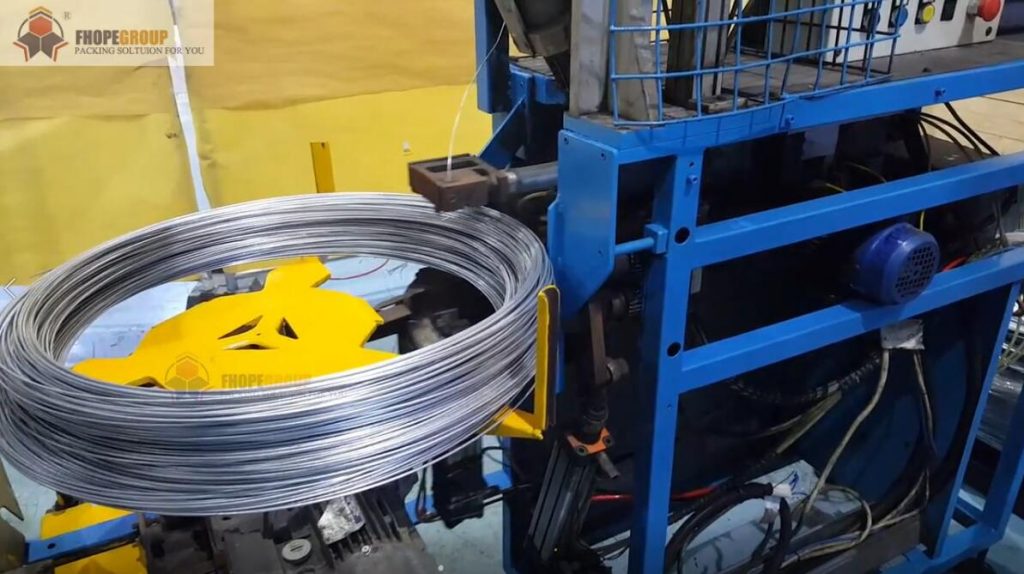
A blue framed winding machine feeds bright steel wire over an orange guide wheel into a vertical cage take-up on a geared, rotating base. The layers build evenly while the operator watches the panel with its speed displays and emergency stop.
جدول المحتويات
- What the winder does
- The winding cycle
- Spool, flyer or cage take-up
- Tension and speed control
- نطاقات نموذجية
- Coil mass and wire length
- Why an accumulator or two heads
- قائمة التحقق من الاختيار
- سلامة
- أسئلة وأجوبة هندسية
- الخطوة التالية
- القراءة ذات الصلة
- مصادر
What the winder does
Drawn steel wire leaves the line on large carriers, but customers buy it in coils of a set weight or length. The winder rewinds it into those coils. Manual winding gives loose laps, wrong lengths and tangled coils at the pay-off. An automatic winder keeps tension steady, counts length and lays each turn in place, so the coil pays off cleanly at the customer.
The winding cycle
- الغذاء: wire comes from the pay-off or drawing block over guide wheels.
- الجهد: a tension unit keeps the wire tight, and a synchronous device matches take-up speed to line speed.
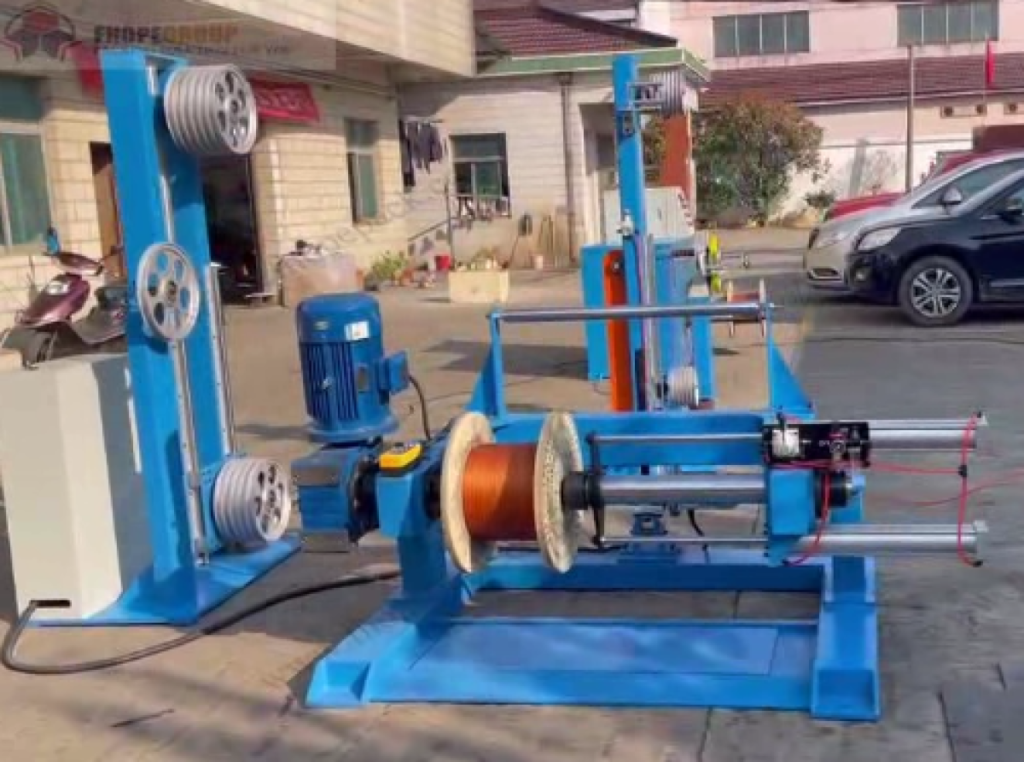
- الرياح: the take-up turns while a servo traverse, or the cage geometry, lays the turns evenly.
- عدد المشاهدات: a meter counter measures length to 0.01 m and slows the machine before the set length.
- Cut and change: the wire is cut, the full coil is released and the next coil starts.
The PLC stores each reel specification, so a product change means loading a stored recipe, not resetting the machine.
Spool, flyer or cage take-up
| ارفع | How turns are laid | أفضل ل |
|---|---|---|
| Spool with traverse | spool turns, a servo traverse moves the wire across | small coils of fine and medium wire |
| نشرة إعلانية | a rotating arm lays wire onto a still coil former | twist-free coils for some cable and wire grades |
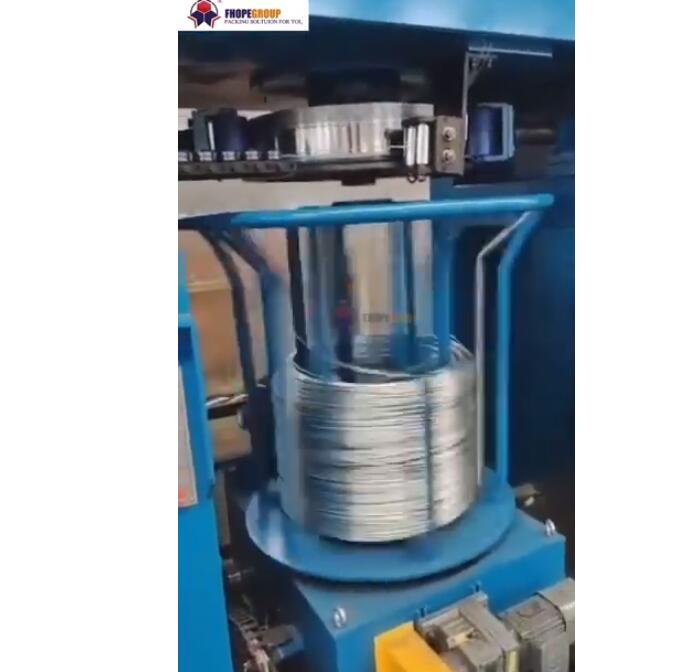
| Vertical cage | wire is laid into a rotating cage on a vertical axis | heavier coils that are lifted off and strapped |
On our coiling line the servo traverse is linked to the winding head, so the pitch follows the wire diameter set in the recipe.
Tension and speed control
Too little tension gives a soft coil that collapses; too much stretches the wire or breaks it. On our steel wire coiling line, tension is set from a DC 24 V tension control cabinet. A synchronous device controls the take-up speed to avoid overstretch or wire break, and the machine stops at once if the wire breaks.
نطاقات نموذجية
| العناصر | FHOPE steel wire coiling line (example) |
|---|---|
| قطر السلك | 1.8 – 5.0 مم |
| سرعة قصوى | 500 م / دقيقة |
| ارتفاع المركز | سماكة 1,000 ملم |
| حجم الملف | ID 400 mm, OD 500 mm, width 55 mm |
| الوزن فائف | 10-30 كجم |
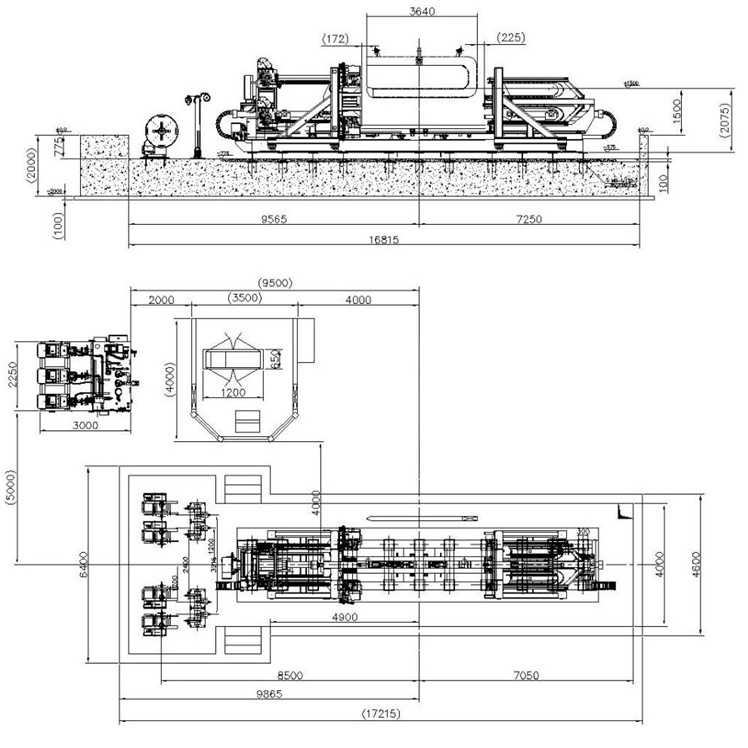
| الناتج | 15–20 coils per hour (one head), 30–40 (double head) |
| تراكم | 5–20 m of wire |
| Length counting | 0.01 m resolution |
Larger coils and heavier wire, like the cage take-up above, are sized per project and confirmed at quote.
Coil mass and wire length
Coil mass (solid) = π/4 × (OD² − ID²) × width × steel density. For the 500 / 400 / 55 mm coil: π/4 × (0.5² − 0.4²) × 0.055 × 7,850 = 30.5 kg if packed solid (example only). Real coils have gaps between turns, so expect less.
Wire length = coil mass ÷ mass per metre. A 3 mm wire has 7.07 mm² cross-section, or 0.0555 kg/m. A 30 kg coil holds 30 ÷ 0.0555 = 540 m, which takes about 540 ÷ 500 = 1.1 min at full speed (example only).
Why an accumulator or two heads
Buffer time = accumulator length ÷ line speed. A 20 m accumulator at 500 m/min buys only 20 ÷ 500 × 60 = 2.4 s. That is enough to ride through a speed change, but not a coil change. For continuous drawing lines we use two winding heads: one winds while the other is emptied, which is why output doubles from 15–20 to 30–40 coils per hour.
قائمة التحقق من الاختيار
- Wire diameter and grade?
- Line speed in m/min?
- Coil ID, OD, width and target weight or length?
- Single head or double head?
- Strapping, wrapping or weighing after winding?
- Pay-off type: drawing block, carrier or spool?
سلامة
The machine is designed to EN ISO 12100:2010 for risk assessment, EN 415-10 for packaging machine safety and EN 60204-1 for electrical equipment. The rotating take-up and running wire are the main hazards, so fence the winding zone with interlocked access or a light curtain. Keep limit switches at both ends of the accumulator and the emergency stop within reach.
أسئلة وأجوبة هندسية
Q: What wire sizes can it wind? A: Our steel wire coiling line handles 1.8–5.0 mm; other sizes are confirmed at quote.
Q: How accurate is the length? A: The meter counter reads to 0.01 m and slows the machine before the set length.
Q: What if the wire breaks? A: Wire-break detection stops the machine at once, and the synchronous take-up control is there to prevent the overstretch that causes most breaks.
Q: Can it strap the coil too? A: Yes, strapping with PET or PP strap at 2 or 4 points can follow, plus wrapping, weighing and labeling.
الخطوة التالية
- Send your wire size, line speed and coil spec إلى info@fhopepack.com.
- نحن نحدد المقاسات the winder, tension unit and downstream packing.
- نقوم بالرد خلال 24 ساعة مع تقديم عرض سعر واقتباس.
القراءة ذات الصلة
- Automatic steel wire coil packing machine (product)
- Automatic wire coiler (product)
- آلة لف الأسلاك الملفوفة FPW-300 (المنتج)
- آلة لف وربط الأسلاك الفولاذية الأوتوماتيكية
- Cable winding and strapping machine (product)
مصادر
- FHOPE quotation: automatic steel wire coiling and strapping machinery (2018)
- FHOPE product page: steel wire winding and wrapping machine
- إن آيزو 12100:2010؛ إن 415-10؛ إن 60204-1
- The steel wire winding machine shown above
آخر مراجعة: 2026-10-20