ملخص تنفيذي
A self-adaptive random case sealer takes cartons of different sizes in any order, measures each one as it enters, moves its side belts and top tape head to fit, and tapes the top and bottom flaps. No one changes the format between sizes. Our equivalent solution fits at the end of a packing line, before stacking and pallet wrapping. Below we explain how the machine adapts, work out the carton rate and tape use, list what makes a carton seal well, and show where the sealer sits in a line.
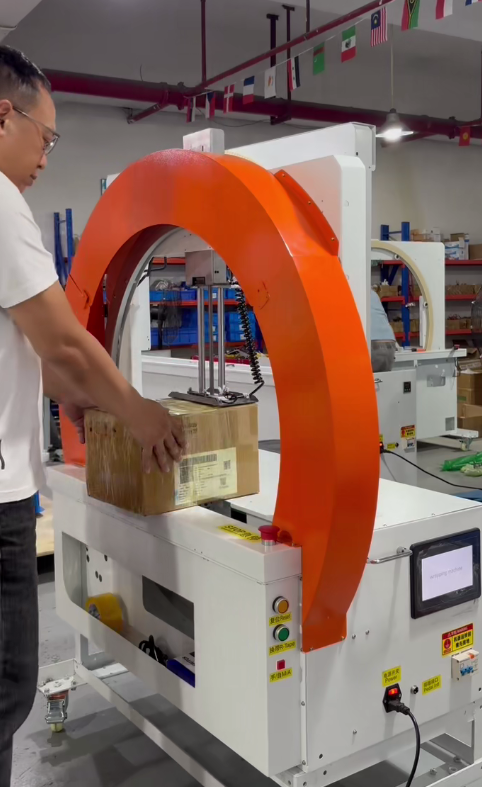
An operator places brown corrugated cartons, one at a time and short side first, onto the in-feed conveyor of a white sealer. Two black columns carry the top head with its red and yellow pneumatic parts, and a touch screen is mounted on an arm above the frame. The control cabinet beside it has a red mushroom emergency stop, and the machine stands on castors.
جدول المحتويات
- لماذا تعيق الأحجام العشوائية عمل مادة مانعة للتسرب ثابتة؟
- How the sealer adapts to each carton
- Cartons per minute
- شريط لاصق لكل كرتونة
- What makes a carton seal well
- Where the sealer sits in a line
- قائمة التحقق من الاختيار
- سلامة
- أسئلة وأجوبة هندسية
- الخطوة التالية
- القراءة ذات الصلة
- مصادر
لماذا تعيق الأحجام العشوائية عمل مادة مانعة للتسرب ثابتة؟
A fixed sealer is set by hand for one carton: the side belts are wound in to the width and the top head is lowered to the height. When the next order comes in a different carton, the line stops while someone resets it. In e-commerce, spare parts and mixed-order packing, sizes change from one carton to the next, so a fixed sealer either stops constantly or needs one machine per size. A random sealer removes that changeover.
How the sealer adapts to each carton
- The carton enters on the in-feed conveyor.
- Sensors read its height and width.
- The side belts close in to the width and grip the carton, and the top head comes down to its height.
- The top flaps are closed, and the top and bottom tape heads apply tape along the seam as the belts carry the carton through.
- The belts and head open again for the next carton, whatever its size.
The movements are pneumatic and motor-driven and set from the touch screen.
Flap closing is the point to settle before ordering. On a fully automatic sealer, a front folder closes the leading minor flap, a rear folder the trailing one, and side rails fold the major flaps.
On a simpler sealer the operator closes the top flaps by hand before the carton enters, as with manual feeding. Which folding units your machine has, and the air supply they need, are confirmed at quote. The carton size range, tape width and belt speed are confirmed at quote for your cartons.
Cartons per minute
The rate depends on belt speed, carton length and the gap the machine needs to reset between cartons:
Cartons per minute = belt speed ÷ (carton length + reset gap).
| Belt speed (example) | طول الكرتون | Reset gap (example) | نتيجة |
|---|---|---|---|
| 20 م / دقيقة | 0.4 م | 0.6 م | 20 ÷ 1.0 = 20 per minute |
| 20 م / دقيقة | 0.6 م | 0.6 م | 20 ÷ 1.2 ≈ 17 per minute |
Random sealers lose some rate to the reset between sizes. Feeding cartons long side first raises the length term and lowers the rate, so they run short side first. The real belt speed and reset gap for your machine are confirmed at quote.
شريط لاصق لكل كرتونة
Each seam takes the carton length plus a tape leg down the front and back:
Tape per carton = 2 × (carton length + 2 × leg length), for top and bottom.
With an example 0.4 m carton and 60 mm legs: 2 × (0.40 + 0.12) = 1.04 m per carton. At 20 cartons a minute over a 7.5 h shift that is 20 × 60 × 7.5 = 9,000 cartons and about 9,400 m of tape. The leg length is set on the tape head and confirmed with the machine.
What makes a carton seal well
| تحقق | لماذا يهم |
|---|---|
| Flaps fold square to the body | a skewed flap leaves a gap the tape cannot close |
| Product does not overfill | a bulging top flap pushes the tape off the seam |
| Product does not underfill | the top head presses a weak carton in |
| Carton board is dry | damp board loses tape adhesion |
| Minor flaps close before major flaps | the major flaps must meet over a flat surface |
Where the sealer sits in a line
In a full end-of-line system the case sealer sits after the case packer and before stacking. Our automatic coil packing lines, for example, run shrink wrapping, case packing, case sealing, stacking and pallet wrapping as one flow. A random sealer lets that line pack mixed sizes with no format change, and the pallet wrapper downstream takes the mixed stacks.
قائمة التحقق من الاختيار
- Smallest and largest carton length, width, height and weight.
- كرتون في الدقيقة.
- Tape width and tape type.
- Manual feeding or a conveyor from a case packer, and who closes the top flaps.
- Top and bottom sealing, or top only.
- Space and power at the sealer position.
سلامة
We design to EN ISO 12100:2010 for risk assessment, EN 415-10 for general packaging machine safety and EN 60204-1 for the electrical equipment. The tape head blades and the closing side belts are the hazards, so the tape heads are guarded and the in-feed and out-feed openings are sized so that a hand cannot follow the carton in. The red mushroom emergency stop is on the control cabinet. Guarding and CE documents are agreed per project.
أسئلة وأجوبة هندسية
Q: Does the operator have to set the carton size? A: No. The sealer measures each carton on the in-feed and moves its belts and top head to fit.
Q: Can sizes change from one carton to the next? A: Yes. The sensing system and the pneumatic actuators set height and width again for every incoming carton.
Q: How many cartons a minute? A: Belt speed divided by carton length plus reset gap. In the example above, 20 m/min with 0.4 m cartons and a 0.6 m gap gives 20 cartons a minute. The bigger the size change between consecutive cartons, the longer the reset.
Q: Does it seal the bottom too? A: Top and bottom tape heads are the usual configuration, confirmed at quote.
Q: Can it be moved? A: The frame stands on castors, so it can be moved to another line.
الخطوة التالية
- Send your carton sizes and cartons per minute إلى info@fhopepack.com.
- نحن نتحقق the size range and the line position.
- نقوم بالرد خلال 24 ساعة مع تقديم عرض سعر واقتباس.
القراءة ذات الصلة
- Automatic cable winding and packing machine (product)
- Automatic pallet wrapping machine B100 (product)
- خط تعبئة البليت الأوتوماتيكي وآلة الربط
- منصة نقالة أوتوماتيكية و غلاف ممتد للصندوق الدوار
- FHOPE carton sealer
- خط آلات تغليف البليت الأوتوماتيكي بالكامل
مصادر
- FHOPE knowledge base: automatic coil packing line with shrink, case packing, sealing, stacking and pallet wrapping (FPCA family)
- إن آيزو 12100:2010؛ إن 415-10؛ إن 60204-1
آخر مراجعة: 2026-10-19